




A business can have a great product, excellent service, and a team that genuinely cares about customers—but still struggle to get noticed online. The problem is often not the quality of the business. It is the absence of the right digital marketing strategy.
Today, customers search on Google, compare brands on social media, read online content, click advertisements, check reviews, and then decide whether a company deserves their attention. If your business is visible in only one of these places, you may be losing potential customers before they ever contact you.
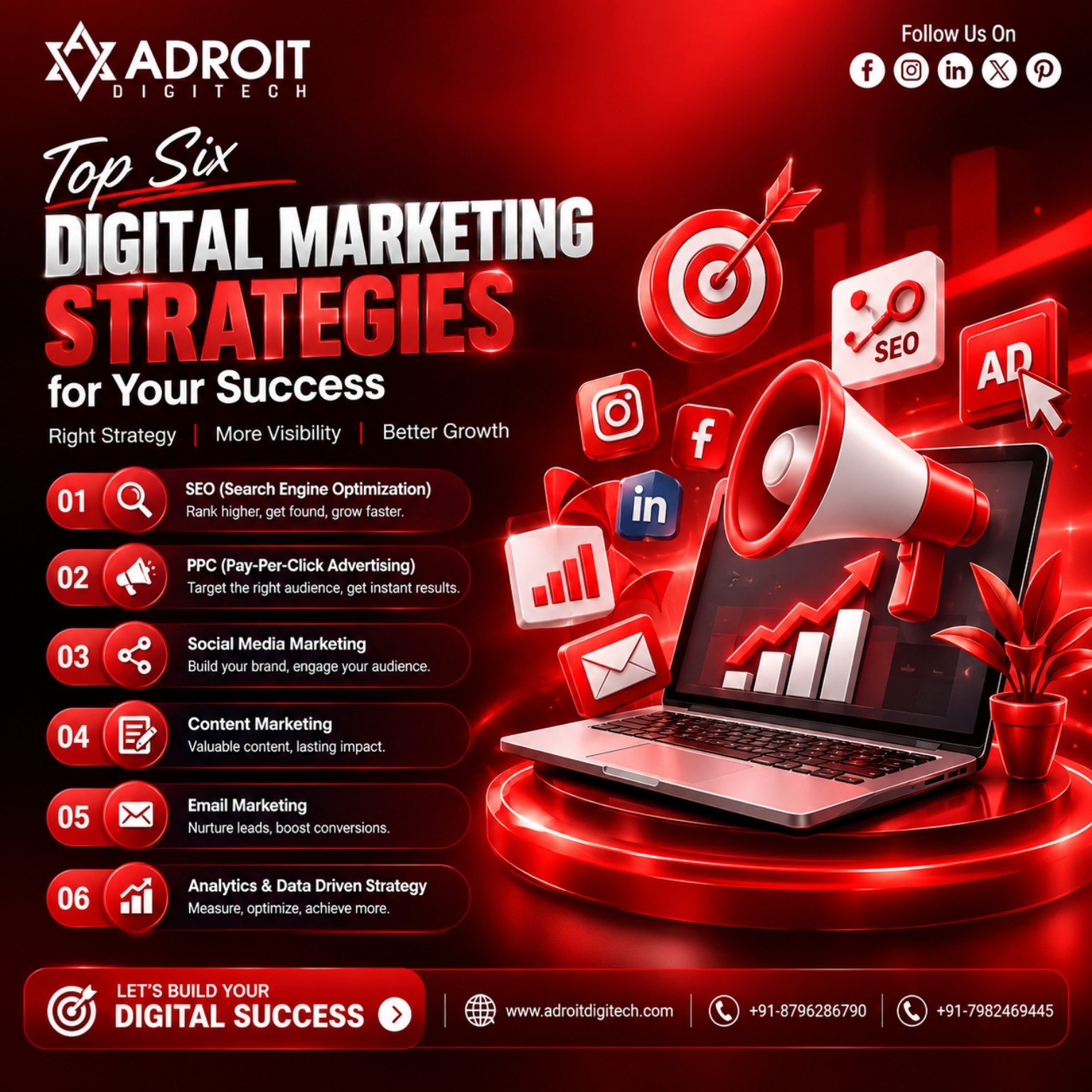
The image highlights six important digital marketing strategies: SEO, PPC advertising, social media marketing, content marketing, email marketing, and analytics/data-driven strategy. These are not isolated activities. When planned together, they can create a complete digital growth system—from getting discovered to generating leads, nurturing prospects, and improving conversions.
For businesses operating in Delhi and Delhi NCR, where competition exists across almost every industry, having a structured approach becomes even more important.
Why Are Businesses Struggling to Get Results Online?
One of the most common mistakes businesses make is treating digital marketing as simply “running advertisements”. A company may spend money on Google Ads or social media promotions, but if its website is difficult to use, its content is weak, or its audience targeting is incorrect, the campaign may produce clicks without meaningful business results.
Consider a local service company in Delhi. Someone searches Google for a service they provide. Another competitor appears prominently in search results, has useful information on its website, maintains an active social presence, and provides a clear way to request a quote. Even if your service is equally good—or better—the customer may never discover you.
This is the real digital marketing challenge: visibility alone is not enough. Your business needs to be visible to the right people, at the right moment, with the right message.
The Customer Pain Point: Traffic Without Business Growth
Getting website traffic sounds positive, but traffic by itself does not guarantee revenue.
A website may receive hundreds of visitors but generate very few enquiries. A social media account may have thousands of followers but limited sales. An advertising campaign may receive clicks while producing expensive or unqualified leads.
Why does this happen?
Because every stage of the customer journey matters.
A potential customer first needs to discover your business. Then they need a reason to trust it. After that, they need enough information to consider the service and an easy way to take action.
That is why successful digital marketing combines search visibility, paid advertising, social engagement, useful content, customer communication, and measurable data rather than depending on one channel.
Why the Right Digital Marketing Strategy Matters
The purpose of digital marketing is not simply to be present everywhere. It is to create a predictable path from visibility → attention → trust → enquiry → conversion → customer retention.
For example, SEO can help a business appear when someone actively searches for its services. PPC can provide immediate visibility for competitive search terms. Social media can build familiarity and engagement. Content marketing can answer customer questions before a sales conversation happens. Email marketing can keep potential customers connected, while analytics can reveal what is actually producing results.
The strongest strategy is therefore not necessarily the one with the biggest budget. It is the one that connects different marketing activities to specific business objectives.
The Six Digital Marketing Strategies Your Business Should Consider
1. SEO — Build Long-Term Search Visibility
Search Engine Optimisation (SEO) helps improve a website’s visibility in organic search results.
Imagine a customer searching for “digital marketing company in Delhi NCR”. If your website is relevant, technically healthy, useful, trustworthy, and properly optimised, it has an opportunity to appear in search results.
SEO is more than inserting keywords into website pages. Modern SEO involves understanding search intent, creating helpful content, improving website structure, optimising important pages, strengthening internal linking, addressing technical issues, and building relevant authority.
For a local business, local SEO is equally important. Location-specific searches can connect businesses with customers who are actually looking for services in their area.
The major advantage of SEO is its long-term potential. Unlike a paid campaign that stops generating traffic when the budget stops, strong organic visibility can continue attracting relevant visitors over time.
However, SEO requires patience. Businesses should avoid expecting meaningful organic growth overnight. A properly planned SEO campaign focuses on building sustainable visibility rather than chasing short-term rankings.
2. PPC Advertising — Reach the Right Audience Faster
PPC (Pay-Per-Click) advertising is useful when a business wants faster visibility and targeted traffic.
Platforms such as Google Ads allow businesses to reach people based on searches, interests, locations, audiences, and other targeting signals. This makes PPC particularly useful for businesses with specific commercial goals.
For example, a Delhi-based web development company may create campaigns targeting users actively searching for website development services. Instead of waiting for organic rankings, the business can potentially appear in sponsored search positions when relevant searches occur.
But successful PPC is not simply about increasing the advertising budget.
Campaign structure, keyword selection, search intent, ad copy, audience targeting, landing-page experience, conversion tracking, and ongoing optimisation all influence performance.
A common mistake is sending every advertisement to the homepage. A dedicated landing page that directly matches the customer’s search intent can often provide a much clearer journey from click to enquiry.
3. Social Media Marketing — Build Brand Recognition and Engagement
Social media marketing helps businesses stay connected with their audience beyond search engines.
Platforms such as Instagram, Facebook, LinkedIn, and other social networks can be used differently depending on the target audience and business type.
For a professional B2B service, LinkedIn content may be particularly valuable for expertise and business networking. For visually driven industries, Instagram can support brand discovery and engagement.
The important point is that social media should not become a collection of random promotional posts.
Customers want useful information, practical advice, demonstrations, stories, insights, and reasons to trust a brand. A business that consistently provides value has more opportunities to build familiarity.
Social media can also support other marketing channels. A useful blog post can be shared socially. A successful advertisement can introduce new users to a landing page. Customer questions can reveal future content ideas.
In this way, social media becomes part of the broader digital marketing strategy rather than a separate activity.
4. Content Marketing — Give Customers a Reason to Trust You
Content marketing focuses on creating useful information that helps potential customers solve problems and make decisions.
Think about what customers search for before contacting a business.
They may ask:
“Which digital marketing strategy is best for a small business?”
“How much does SEO cost?”
“Is Google Ads better than SEO?”
“How can I generate more local leads?”
“What should I check before hiring a digital marketing agency?”
These searches represent opportunities to educate potential customers.
A strong content strategy answers those questions clearly instead of turning every article into a sales pitch.
For example, a digital marketing agency serving Delhi NCR could create content explaining local SEO, Google Ads campaign planning, social media strategy, website conversion optimisation, and common marketing mistakes. Such content can attract relevant visitors while demonstrating expertise.
Good content does not merely target search engines. It helps real people. That is what makes content more valuable for both users and long-term search visibility.
5. Email Marketing — Turn Leads Into Long-Term Relationships
Not every potential customer is ready to buy the first time they discover your business.
Someone may visit your website today, compare several providers tomorrow, and make a decision several weeks later.
This is where email marketing can support lead nurturing.
With permission-based email communication, businesses can share useful resources, updates, educational content, offers, product information, or relevant company news.
The objective should not be to send promotional emails every day. Excessive promotion can quickly reduce engagement.
Instead, think about the customer’s journey. What information would help them move from uncertainty to confidence?
For a service business, this might include an educational guide, case study, explanation of the process, answers to common questions, or information about available services.
Effective email marketing focuses on relevance and relationship, not simply sending a larger number of emails.
6. Analytics & Data-Driven Strategy — Measure What Actually Works
Perhaps the most overlooked part of digital marketing is measurement.
Without analytics, businesses can easily spend money based on assumptions.
A data-driven strategy asks important questions:
Which marketing channel generates the most qualified enquiries?
Which pages attract the most visitors?
Which keywords bring commercial traffic?
Which advertisements generate conversions?
Where are website visitors leaving?
Which campaigns produce customers rather than just clicks?
These insights help marketers make better decisions.
For example, if an advertising campaign generates a large number of clicks but very few enquiries, increasing its budget may not solve the problem. The issue could be targeting, messaging, landing-page quality, or the conversion process.
Analytics turns marketing from guesswork into an ongoing process of testing, learning, optimising, and improving.
How These Six Strategies Work Together
The real strength comes when these strategies are connected.
A customer might discover your business through Google SEO. They may later see your social media content, click a PPC advertisement, read one of your educational articles, submit an enquiry, and receive follow-up communication through email.
Analytics can then show which parts of this journey are performing well and where improvements are needed.
This creates a connected marketing ecosystem instead of six disconnected campaigns.
For a growing business, the objective should therefore be to identify which channels match its audience, budget, industry, sales cycle, and growth goals.
Practical Example: A Delhi NCR Business
Imagine a professional services company wants to generate more enquiries from Delhi NCR.
The first step could be optimising its website for relevant service and location-based searches. Useful content can then answer common customer questions. PPC campaigns can target high-intent searches where immediate visibility matters.
Social media can build brand awareness and demonstrate expertise. Email can nurture enquiries that are not ready to purchase immediately. Analytics can measure leads, conversion rates, campaign performance, and customer acquisition costs.
Instead of asking, “Which one marketing service should we use?”, the better question is:
“Which combination of strategies will help us reach our specific customers and achieve our business goal?”
Common Digital Marketing Mistakes Businesses Should Avoid
One major mistake is trying to use every platform without a clear strategy. Being active everywhere does not automatically produce better results.
Another problem is focusing entirely on vanity metrics. Followers, impressions, and clicks can be useful indicators, but businesses ultimately need to understand whether marketing is contributing to qualified leads, sales, and sustainable growth.
Ignoring the website is another costly mistake. Even excellent advertising can underperform when the landing page loads slowly, looks outdated, lacks clear information, or makes it difficult for visitors to contact the business.
Keyword stuffing is also something businesses should avoid. Search optimisation should focus on relevance and user intent rather than repeatedly inserting the same keyword.
Finally, businesses should not expect immediate results from every channel. SEO and content often require consistent effort, while PPC can produce faster traffic but needs continuous optimisation. Different channels have different roles.
How to Choose the Right Digital Marketing Strategy
The right approach depends on your business.
Start with your objective. Do you need immediate enquiries, stronger organic visibility, better brand awareness, customer retention, or a combination of these?
Next, understand your audience. What do they search for? Which platforms do they use? What problems are they trying to solve? How long does it usually take them to make a purchasing decision?
Then evaluate your existing digital presence. Your website, Google visibility, social media profiles, content, advertising campaigns, and conversion process should be reviewed together.
Finally, establish measurable KPIs. Instead of simply saying “we need more traffic”, define what success means—for example, more qualified leads, improved conversion rates, lower acquisition costs, or increased organic enquiries.
A professional digital marketing strategy should be customised around business goals, not copied from another company.
Digital Marketing Services for Businesses in Delhi & Delhi NCR
This is where Adroit Digitech can become a practical partner for businesses looking to build a structured online growth strategy.
The services highlighted in the image cover the six core areas: SEO, PPC advertising, social media marketing, content marketing, email marketing, and analytics/data-driven strategy.
For businesses in Delhi and the wider NCR market, combining these services can help create a more consistent customer journey. Instead of treating every marketing channel independently, the focus can remain on the complete process—from increasing visibility and attracting the right audience to generating enquiries and measuring performance.
Whether a business needs stronger local search visibility, targeted advertising, social media engagement, useful content, lead nurturing, or better marketing measurement, the strategy should always begin with the company’s actual objectives and audience.
That approach is particularly important in competitive local markets, where customers can compare multiple businesses within seconds.
Frequently Asked Questions
What are the six main digital marketing strategies?
The six strategies highlighted in this guide are SEO, PPC advertising, social media marketing, content marketing, email marketing, and analytics/data-driven strategy. Together, they cover visibility, traffic acquisition, engagement, education, lead nurturing, and performance optimisation.
Which digital marketing strategy is best for a small business?
There is no single strategy that is best for every small business. Local SEO, content, social media, and targeted PPC can all be valuable, but the right combination depends on the business’s audience, competition, budget, location, and objectives.
Is SEO better than PPC?
SEO and PPC serve different purposes. SEO can support long-term organic visibility, while PPC can provide faster targeted exposure. Many businesses benefit from using both strategically rather than treating them as competitors.
How does social media help a business?
Social media can increase brand awareness, encourage engagement, demonstrate expertise, distribute content, and create additional opportunities for customers to discover a business.
Why is analytics important in digital marketing?
Analytics helps businesses understand what is working and what is not. It can reveal traffic sources, user behaviour, conversions, campaign performance, and areas that need improvement.
Is content marketing important for SEO?
Yes. Useful, relevant content can help businesses address customer search intent, demonstrate expertise, attract organic visitors, and support broader SEO efforts. Content should be created primarily for users rather than written only to insert keywords.
Can digital marketing help local businesses in Delhi NCR?
Yes. Local search optimization, location-relevant content, targeted advertising, social media, and conversion-focused websites can help businesses reach customers in Delhi NCR. The exact strategy should depend on the service area and target audience.
Ready to Build Your Digital Success?
Digital marketing works best when every activity has a purpose. SEO builds visibility. PPC creates targeted opportunities. Social media builds engagement. Content builds trust. Email nurtures relationships. Analytics tells you what to improve.
The goal is not simply to market more. It is to market smarter.
If your business is ready to improve its online visibility, attract relevant customers, generate better leads, and build a measurable digital growth strategy, connect with Adroit Digitech and start with a strategy designed around your business goals.
Let’s build your digital success with the right strategy, the right audience, and measurable growth.

I like this site so much, saved to my bookmarks.
You should take part in a contest for one of the best blogs on the web. I will recommend this site!
Hmm it looks like your site ate my first comment (it was extremely long) so I guess I’ll just sum it up what I wrote and say, I’m thoroughly enjoying your blog. I too am an aspiring blog blogger but I’m still new to everything. Do you have any tips and hints for novice blog writers? I’d genuinely appreciate it.
Absolutely pent articles, Really enjoyed reading.
I conceive this web site contains some real great information for everyone :D. “I like work it fascinates me. I can sit and look at it for hours.” by Jerome K. Jerome.
This is really fascinating, You are an overly skilled blogger. I have joined your rss feed and sit up for in the hunt for extra of your excellent post. Additionally, I have shared your website in my social networks!