




A customer sees a delicious burger, opens a food ordering app, checks the menu, selects an item, adds it to the cart and expects the order to be completed within a few simple taps. But when an app is confusing, slow, difficult to navigate or poorly designed for mobile users, that simple journey can break. The customer may leave before placing the order.
This is the biggest pain point for restaurants, cafés, cloud kitchens and food brands: turning customer interest into a completed online order without unnecessary friction.
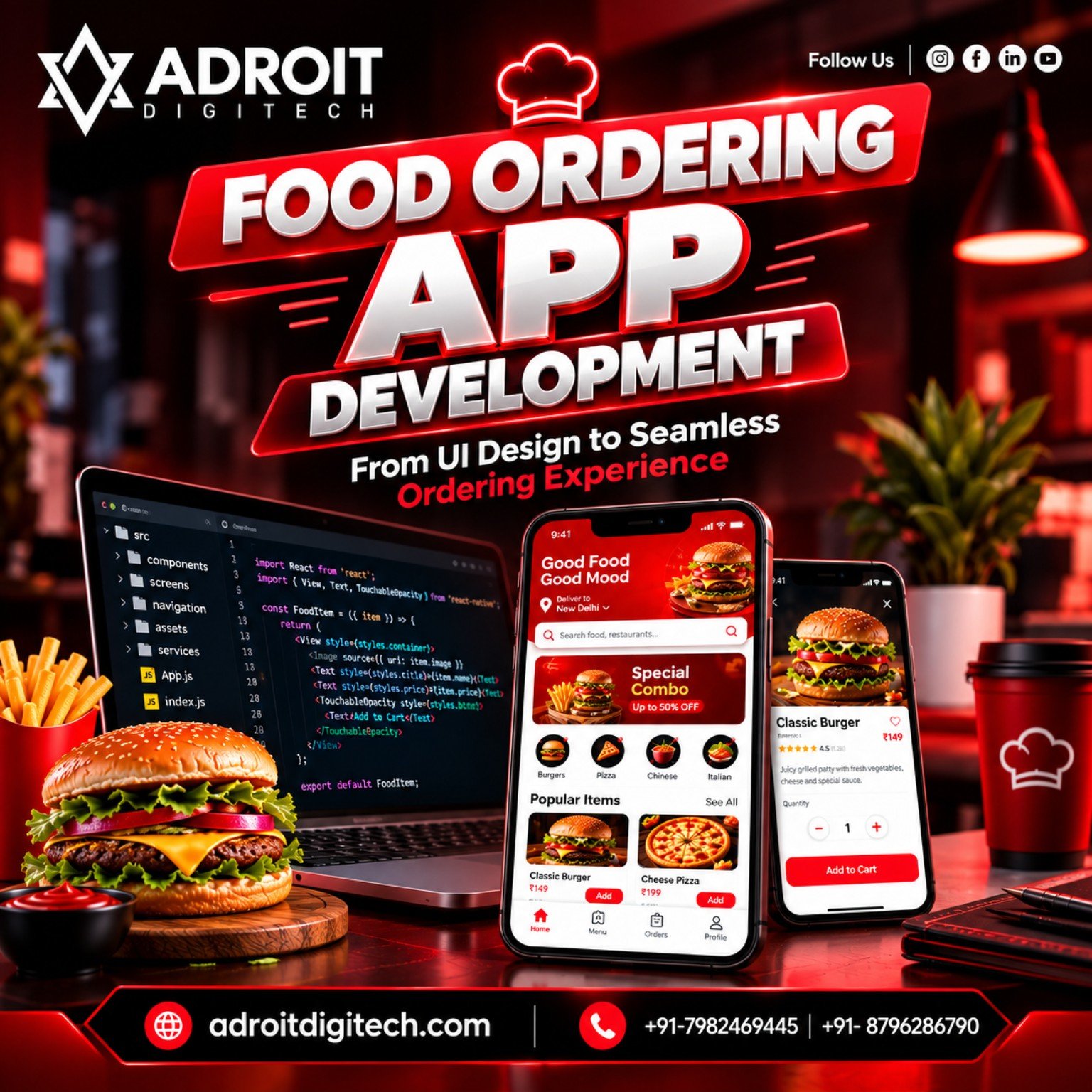
The visual represents exactly this journey. It combines a restaurant environment, food products, a laptop showing development code and mobile screens displaying a modern food ordering interface. From UI design and menu browsing to product selection, cart management and ordering, every element represents one part of a complete digital ordering experience.
For a food business, a mobile app should not simply display a menu. It should make ordering feel natural, quick and convenient.
Why Food Ordering App Development Matters for Modern Food Businesses
Customers are increasingly comfortable discovering food through digital channels. They want to see the menu, compare products, check prices, customise their order and complete checkout without having to call the restaurant.
This creates an opportunity for restaurants and food businesses to build a direct digital ordering experience. But having an application alone does not guarantee a better customer experience. The application needs to be planned around how people actually order food.
A customer usually does not want to navigate through complicated screens. They want to open the app, understand what is available, find something appealing, check the details and place the order. Every unnecessary step can create friction.
That is why food ordering app development involves much more than writing code. It combines UI/UX design, mobile development, menu presentation, cart functionality, checkout, payment integration and order management into one connected experience.
The Biggest Problem: Customers Want Fast and Simple Ordering
Imagine a customer opening a restaurant app because they want a burger. The home screen should immediately help them discover the menu. They should be able to search or browse categories, open the product, understand the price and description, choose available options and add it to their cart.
The image shows this concept clearly. The mobile interface contains food categories, popular items, prices and an Add to Cart action. These details may appear simple, but together they remove unnecessary decisions from the customer’s ordering journey.
Now consider the opposite experience. The menu is difficult to find, product information is unclear, buttons are difficult to tap, prices are confusing and checkout requires too many steps. Even if the restaurant has excellent food, the digital experience can become a barrier.
The objective of a professional restaurant ordering app is therefore not to make the customer work harder. It is to make the ordering process easier.
UI/UX Design Is the Foundation of a Food Ordering App
The first thing customers experience is not the backend technology. They experience the interface.
A professional food ordering app UI/UX design should make the most important actions immediately understandable. The home screen needs a clear structure. Food categories should be easy to browse. Product cards should provide useful information without becoming crowded. Buttons such as “Add to Cart” should be visually clear and easy to use.
Food is also highly visual. High-quality product images can help customers understand what they are ordering, while clear descriptions and pricing help them make informed decisions. The interface should therefore give enough space to the actual food products instead of overwhelming customers with unnecessary design elements.
The image’s mobile screens demonstrate this approach through food photography, category icons, product information, prices and prominent ordering actions. The visual design supports the purpose of the application: helping the customer order food.
From Food Menu to Product Selection
A digital food menu should reproduce the useful parts of a physical menu while making the experience more interactive.
Categories can help customers quickly move between burgers, pizza, Chinese food, Italian food, beverages, desserts or other menu sections. Search can help customers find a specific item without scrolling through the entire menu.
When a customer opens a product, the application should provide the information needed for a decision. Depending on the business, this may include product images, ingredients, descriptions, pricing, sizes, flavours, toppings, add-ons or special instructions.
For example, a burger restaurant may allow customers to choose a size, add cheese, select additional toppings and adjust quantity. A pizza business may offer different crusts, sizes and toppings. A cloud kitchen may have completely different customisation requirements.
The application should be designed around these real business situations rather than using the same ordering structure for every food company.
Cart and Checkout Should Remove Friction
Adding food to a cart is only one part of the ordering process. Customers also need to review their selections before placing the order.
A well-designed cart should clearly show selected items, quantities, prices and the total amount. Customers should be able to increase or decrease quantities or remove an item without restarting the ordering process.
The checkout stage should then provide a clear path toward order confirmation. Depending on the business model, customers may need to enter or select a delivery address, choose delivery or pickup, select a payment method and review the final order.
The principle is simple: the customer should always know what has been selected, how much it costs and what action comes next.
This is one of the most important aspects of a seamless food ordering experience.
What a Custom Food Ordering App Can Include
A custom food ordering application can be built around the specific requirements of a restaurant or food brand. Customer registration, food categories, search, product pages, cart management and checkout can form the core ordering journey.
Online payment integration can allow customers to complete transactions digitally, while order notifications can keep them informed after an order has been placed. Depending on the business model, the application can also support pickup orders, delivery orders, address management and order history.
For restaurant owners and staff, an administrative system can make it easier to manage products, categories, prices and incoming orders. If a particular item becomes unavailable, the business may need the ability to update its availability rather than continuing to accept orders for it.
A growing food brand may also require multiple locations, outlet-specific menus, promotional offers, discount codes or other functionality. These features should be introduced according to actual business requirements rather than simply adding features for the sake of making the application appear larger.
Why Mobile-First Food App Development Is Important
The visual is centred around smartphones because food ordering is naturally a mobile activity. Customers may order while sitting at home, working in an office, travelling or visiting a particular area.
That makes mobile usability extremely important.
Buttons need to be easy to tap. Text needs to remain readable. Food images should be displayed properly. Navigation should feel natural on a smaller screen. The cart and checkout should remain easy to access.
A mobile food ordering app should also be designed with performance in mind. Customers generally expect screens to respond quickly. Slow loading, broken images or confusing transitions can negatively affect the ordering experience.
The purpose of mobile-first design is not simply to make a desktop website smaller. It is to create an experience specifically suited to how people interact with smartphones.
The Technology Behind the Ordering Experience
The laptop shown in the image represents the development side of the project. Customers see the mobile interface, but behind those screens is the technology responsible for processing products, customers, orders and payments.
A complete food ordering app development solution may involve mobile application development, backend systems, database management, API integration, payment services, notifications and an administrative panel.
The technology should support the business rather than complicate it. For example, when a customer places an order, the system needs to process the order information correctly and make that information available to the relevant restaurant team.
Similarly, when the restaurant updates a product price or availability, the customer-facing application should reflect the appropriate information.
This connection between customer interface and business operations is what turns an attractive app into a functional ordering system.
Common Mistakes in Food Ordering App Development
One common mistake is designing an application around appearance instead of customer behaviour. A visually impressive interface can still be difficult to use if the ordering path is unclear.
Another mistake is creating too many steps between selecting food and placing an order. Customers should not be forced through unnecessary screens or asked for information that is not required.
Poor food presentation is another problem. If product images are inconsistent, descriptions are incomplete or prices are unclear, customers may hesitate before ordering.
Businesses can also make the mistake of adding too many features at the beginning. A restaurant does not necessarily need a complicated application with dozens of functions if the basic ordering process is not yet smooth.
Another important mistake is ignoring the restaurant’s operational workflow. The app must work for the people receiving and managing orders as well as the customers placing them.
How to Choose the Right Food Ordering App Development Company
Before selecting a development company, a restaurant should clearly understand its ordering requirements. A single-location restaurant may need a different solution from a multi-outlet food brand or cloud kitchen.
Discuss the menu structure, customer journey, delivery areas, payment requirements, order management process and future expansion plans before development begins.
The UI/UX process should also be discussed in detail. Ask how customers will discover products, how customisation will work, how the cart will function and how checkout will be handled.
It is equally important to understand post-launch support. Food businesses may need future updates, technical maintenance, new features, bug fixes and changes to the menu or ordering workflow.
The right development approach should therefore be based on the business’s actual requirements rather than a generic application package.
How Adroit Digitech Approaches Food Ordering App Development
Adroit Digitech | Digital Marketing & Web Solutions provides website and mobile app development solutions with a focus on creating practical digital experiences for businesses.
For a food business, the development process can be structured around the exact customer journey represented in the image: UI design → food discovery → product selection → cart → checkout → order experience.
The application can be planned according to the restaurant’s branding, menu structure and operational requirements. Instead of treating every food business the same way, the required functionality can be defined according to the business model.
For example, a restaurant may require a branded menu and online ordering system, while a larger food business may require multiple locations, advanced order management, promotional functionality and other custom features.
The focus should remain on creating a digital ordering experience that is simple for customers and practical for the business team managing orders.
Food Ordering App Development in Delhi and Delhi NCR
Restaurants and food businesses in Delhi and Delhi NCR operate in a highly competitive digital environment. A customer searching for food can encounter multiple restaurants offering similar products, which makes the overall digital experience important.
For businesses operating in Delhi, Noida, Gurugram, Faridabad and nearby areas, an ordering application can become one part of a broader digital ecosystem that includes a website, Google Business Profile, social media and online marketing.
For a local restaurant, café or cloud kitchen in areas such as East Delhi, West Delhi, South Delhi, North Delhi or Pandav Nagar, the application can be planned according to the business’s actual menu, service area and ordering process.
Local relevance should not mean filling an app or website with repeated location keywords. The more useful approach is to create a genuine digital experience that serves the customers the business is actually trying to reach.
Why a Seamless Ordering Experience Matters for Business Growth
The purpose of food ordering technology is ultimately connected to the customer journey.
A customer who can quickly find a product, understand it, customise it where necessary, add it to the cart and complete checkout has fewer obstacles between interest and purchase.
That does not mean an app alone guarantees more orders. Food quality, pricing, delivery, customer service, marketing and many other factors also influence business performance. But the application should not create unnecessary friction within the ordering process.
This is why the image’s message is important. It is not simply showing a burger, a phone and some coding. It is showing the connection between food business, technology and customer experience.
Frequently Asked Questions About Food Ordering App Development
What is Food Ordering App Development?
Food Ordering App Development is the process of designing and developing a mobile application that allows customers to browse a food menu, select products, customise items where applicable, add them to a cart, complete checkout and receive information about their order.
How much does a food ordering app cost?
The cost depends on the required features, UI/UX complexity, platforms, payment integration, backend system, admin panel, order management requirements and other technical specifications. A customised quotation should be prepared after understanding the complete project scope.
Can I build a food ordering app for my restaurant?
Yes. A restaurant can develop a branded food ordering application based on its menu, ordering process, customer requirements and business operations.
Can customers pay online through the app?
Yes. Online payment functionality can be integrated according to the selected payment solution and project requirements.
Can a food ordering app support delivery and pickup?
Yes. The ordering flow can be designed to support delivery, pickup or both, depending on how the restaurant operates.
Can multiple restaurant branches use one app?
Yes. A multi-location food ordering application can be developed to support multiple outlets where the business requires location-based menus, order management or other branch-specific functionality.
Why is UI/UX important in a restaurant app?
UI/UX determines how easily customers can browse food, understand product information, select options, add products to their cart and complete checkout. A clear interface reduces unnecessary friction during the ordering journey.
Can Adroit Digitech develop a food ordering app in Delhi NCR?
Adroit Digitech can develop a food ordering application based on the specific requirements of restaurants, cafés, cloud kitchens and food businesses in Delhi and Delhi NCR.
Build a Food Ordering Experience Customers Can Actually Use
A food ordering app should do more than display attractive food images. It should guide the customer from discovering the menu to completing an order with as little unnecessary friction as possible.
That is the central idea behind the visual: from UI design to seamless ordering experience. The code represents the technology, the mobile screens represent the customer journey, and the food represents the business outcome the application is designed to support.
If you are planning a Food Ordering App Development project in Delhi or Delhi NCR, Adroit Digitech can help you plan the UI/UX, application functionality and development scope around your actual business requirements.
Call / WhatsApp: +91-7982469445 | +91-8796286790
Website: adroitdigitech.com
Instagram: Food Ordering App Development
