



Best E-Commerce Website Development Company in Delhi NCR: How to Build an Online Store Customers Trust
Imagine a customer searching for your product on Google. They find your website, click on it, and within a few seconds they see a confusing layout, slow-loading product images, an awkward mobile experience, or a checkout process that asks for too much information.
What happens next?
They leave.
The product may be excellent. Your pricing may be competitive. Your business may have years of experience. But online, the website is often the first real interaction between your brand and a potential customer. If that interaction creates doubt, friction or frustration, the sale can disappear before your customer ever reaches the checkout page.
That is exactly why e-commerce website development is more than simply putting products on a website.
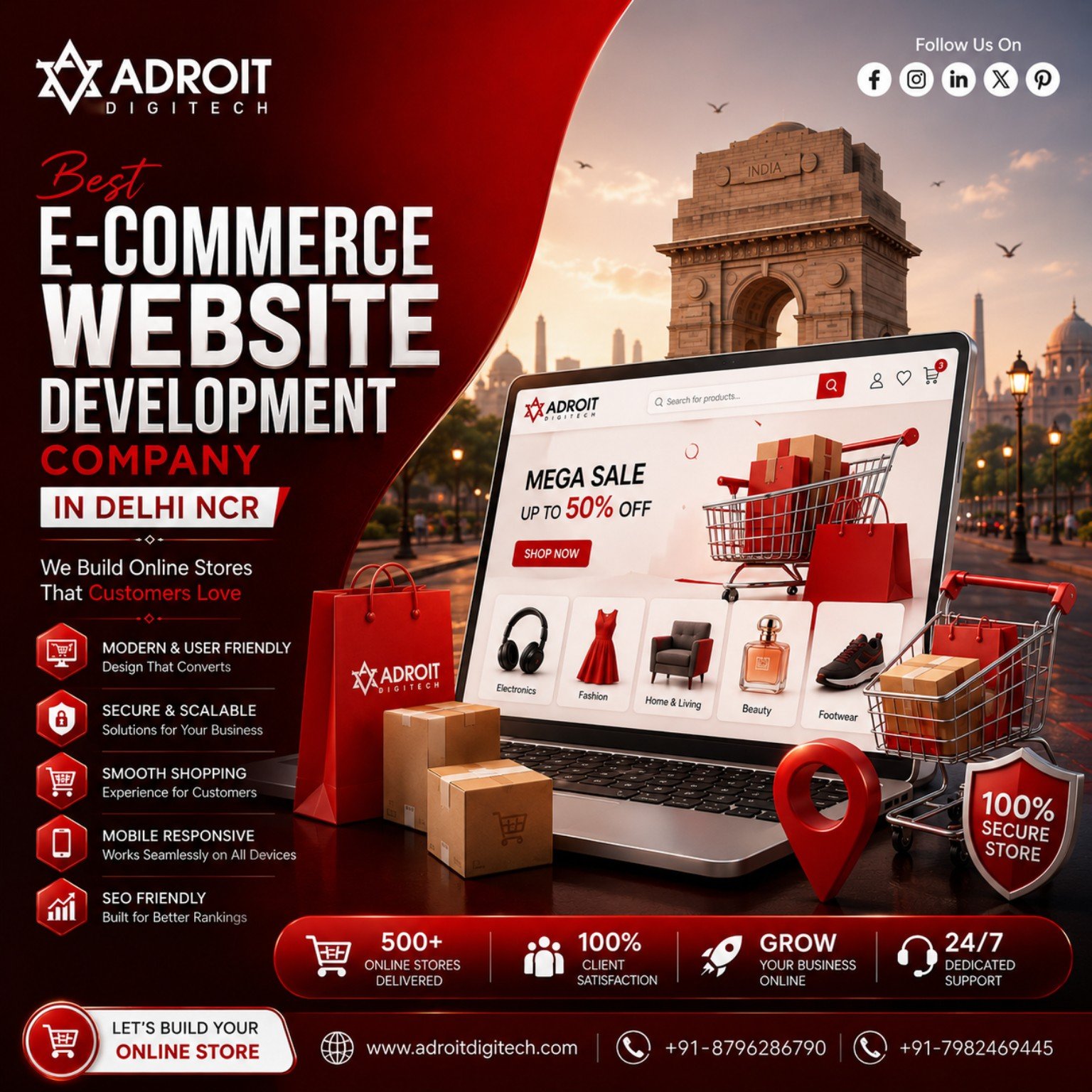
The image behind this article communicates a clear business idea: a modern online store should be visually appealing, secure, mobile responsive, search-engine friendly and easy to use. It presents Adroit Digitech as an e-commerce website development company in Delhi NCR, with a focus on modern online stores, scalable solutions, smooth shopping experiences and SEO-friendly development.
For an entrepreneur, retailer, manufacturer or growing D2C brand, the bigger question is not simply, “Do I need an e-commerce website?”
It is:
“Can my website turn visitors into confident buyers?”
Why a Good E-Commerce Website Matters for Your Business
A physical store has a salesperson, product displays, shelves, lighting and a checkout counter. An online store has to perform many of those jobs digitally.
Your homepage needs to explain what you sell. Your category pages need to help shoppers find products. Product pages need to answer questions. Images need to create confidence. The cart needs to work properly. Checkout needs to feel safe. And the entire experience needs to work comfortably on a smartphone.
This is why professional e-commerce website development in Delhi NCR should begin with business objectives rather than website design alone.
Suppose you sell fashion products. A customer may want to filter products by size, colour and price. If those filters are difficult to use, the customer may abandon the search.
Now imagine an electronics store. Buyers may need specifications, warranty details, delivery information, reviews and comparison options before purchasing.
A furniture business has a different problem. Customers may want dimensions, material information, high-quality photographs and delivery details.
The technology is important, but understanding the customer journey is even more important.
The Real Pain Points Online Store Owners Face
Many businesses launch an e-commerce website with one objective: “Get the website live.”
That is only the beginning.
After launch, several problems can appear. Visitors may come through Google but fail to find the right product. Paid advertising may generate clicks without enough conversions. Customers may add products to their carts but abandon checkout. Mobile users may struggle with small buttons or slow pages.
Another common problem is building a website that looks attractive but is difficult to manage.
An e-commerce business constantly changes. Products go out of stock. Prices change. offers are introduced. New categories are added. Inventory needs updating. Orders have to be managed. Customer information needs to be handled responsibly.
Therefore, the website should not only look good to customers; it should also make business operations easier for the team behind it.
What Makes a Modern E-Commerce Website Successful?
A successful online store brings together design, technology, usability, security and search visibility.
1. Modern and User-Friendly Design
The image specifically highlights a modern and user-friendly design that converts.
That principle is important because customers do not visit an online store to admire its design. They visit to accomplish something: find a product, understand it and decide whether to buy it.
Good e-commerce UX keeps this journey simple.
Navigation should be logical. Categories should be easy to understand. Search should be prominent. Product information should be readable. Important actions such as “Add to Cart” and “Buy Now” should be easy to identify.
A clean design can also make a new brand appear more trustworthy.
2. Mobile Responsive Development
A modern e-commerce website cannot be designed only for desktop computers.
People browse products while travelling, during breaks at work, at home and often from smartphones. If your website looks perfect on a laptop but becomes difficult to navigate on a mobile screen, you are creating unnecessary friction.
Responsive development allows the layout to adapt to different screen sizes.
However, mobile responsiveness is more than shrinking a desktop website. Buttons, product galleries, filters, menus, forms and checkout elements all need to be comfortable for mobile users.
3. Secure Shopping Experience
Trust is critical in e-commerce.
Customers may share their contact information, address and payment details with your website. They need confidence that the store is legitimate and that the transaction process is handled securely.
An e-commerce development project should therefore consider HTTPS, secure integrations, authentication, payment gateway implementation, appropriate access controls and safe handling of customer information.
Security should not be added as an afterthought.
4. SEO-Friendly E-Commerce Architecture
A beautiful online store that cannot be discovered through search is a missed opportunity.
SEO-friendly development involves much more than adding a keyword to a product page. Your site needs a logical structure, crawlable pages, descriptive URLs, useful product content, appropriate internal linking and technically sound implementation.
Google’s current Search documentation also continues to provide specific guidance for e-commerce sites and product-related structured data. Product information can be marked up so that search engines can better understand important product details.
For businesses targeting organic search, development and SEO should therefore work together from the beginning.
How E-Commerce SEO Can Support Organic Growth
Consider a Delhi-based business selling home décor products.
Instead of creating one generic page called “Products”, the website could have meaningful categories such as living room décor, bedroom décor and office accessories. Individual products can then have useful descriptions addressing material, dimensions, care instructions, pricing and other purchase-related questions.
This structure helps both customers and search engines understand the site.
SEO also requires attention to technical details. For example, e-commerce websites can generate multiple URLs through filtering, sorting and product variations. Google explains that canonicalisation helps identify the representative URL when similar or duplicate versions of content exist.
That means SEO-friendly development should consider URL structure and indexing before the website becomes difficult to manage.
Why Page Speed and User Experience Matter
Think about your own online shopping behaviour.
If a product page takes too long to load, you probably do not wait indefinitely. You go back and try another result.
The same thing happens to your customers.
Large product images, unnecessary scripts, poorly configured hosting and inefficient code can all contribute to a slower shopping experience. A professional development process should therefore consider performance from the beginning.
The goal is not simply to make a website “fast” in a vague sense. Developers should identify the elements slowing down the website and monitor real user experience over time.
A fast, usable store can make product discovery and checkout feel much smoother.
The E-Commerce Features Your Business May Actually Need
There is no universal feature list for every online store.
A small catalogue may need a straightforward product management system, search, categories, cart, checkout and payment integration.
A larger store may need product variants, advanced filtering, inventory management, customer accounts, order tracking, coupons, reviews, multiple payment methods and integrations with other business systems.
Depending on the business model, useful features can include the following:
- Product and category management
- Product variations such as size or colour
- Shopping cart and wishlist
- Secure checkout
- Payment gateway integration
- Order management
- Inventory management
- Search and filtering
- Customer accounts
- Discount and coupon functionality
- Product reviews
- Delivery and shipping integration
- Analytics and conversion tracking
- SEO-friendly URLs and metadata
- Mobile-responsive design
The important point is to build features around actual customer and business requirements rather than adding features simply because competitors have them.
Common E-Commerce Website Development Mistakes
Building for appearance instead of conversion
A visually impressive homepage cannot compensate for confusing product pages or a difficult checkout process.
Ignoring mobile users
If mobile visitors have to zoom, scroll excessively or struggle to tap buttons, the shopping experience suffers.
Using weak product descriptions
“Premium quality product” does not answer the customer’s questions.
Useful descriptions explain what the product is, who it is for, how it works, what makes it different and what the buyer should know before purchasing.
Making checkout unnecessarily complicated
Every additional step can create friction. Customers should understand what information is required, what they are paying and how the order will be delivered.
Treating SEO as a final step
Adding SEO after the entire site has been developed can create structural problems that are harder and more expensive to fix later.
Forgetting scalability
A website that works with 50 products may not perform the same way when the catalogue grows to thousands of products and traffic increases.
A scalable architecture gives a business more room to grow.
How to Choose the Right E-Commerce Website Development Company
Choosing an e-commerce website development company in Delhi NCR should not be based only on price.
Start by examining whether the development team understands your business model.
Ask how they approach:
User experience: Will they map the customer’s buying journey before designing the interface?
SEO: Will the website architecture support organic search from the beginning?
Mobile experience: Is the design tested across different screen sizes?
Security: How will payment, customer data and administrative access be handled?
Scalability: What happens if your product catalogue and traffic increase?
Maintenance: Who handles technical issues after launch?
Support: Is there a clear process for resolving website problems?
Business goals: Are they focused only on delivering pages, or do they understand conversions and customer experience?
A reliable development partner should be able to explain technical decisions in business language.
Why Local E-Commerce Development Can Be Valuable for Delhi NCR Businesses
Delhi NCR is a highly competitive market for online businesses. A company may serve customers in Delhi, Noida, Gurugram, Ghaziabad, Faridabad and beyond while also targeting customers across India.
This creates an interesting combination of local and national opportunities.
A Delhi NCR business may initially want customers from nearby areas, but its online store can potentially support a much broader market.
Working with a local e-commerce website development company in Delhi or the wider NCR region can make communication, meetings and understanding of the local business environment easier.
For example, a retailer in Noida may have different logistics requirements from a boutique in South Delhi. A manufacturer in Gurugram may need catalogue functionality and B2B enquiries alongside normal e-commerce sales.
Local understanding does not replace technical expertise, but it can make collaboration more practical.
How Adroit Digitech Approaches E-Commerce Website Development
The image positions Adroit Digitech around a straightforward promise: building online stores that customers love.
Its service message focuses on five core areas—modern user-friendly design, secure and scalable solutions, smooth shopping experiences, mobile responsiveness and SEO-friendly development.
The image also presents Adroit Digitech as an e-commerce website development company in Delhi NCR and highlights experience delivering 500+ online stores, along with dedicated support and business-growth positioning.
For a business owner evaluating a development partner, the more useful takeaway is not simply the number of features or the visual appeal of a promotional creative. The important question is whether the development process connects design, technology, SEO and customer experience into one complete online selling system.
That is where a development partnership can become valuable.
Instead of treating the website as a one-time digital brochure, the goal should be to build an online store that can support product discovery, customer trust, transactions and future growth.
What a Practical E-Commerce Project Should Look Like
A sensible project normally starts with discovery.
The development team first needs to understand what you sell, who your customers are, how many products you have, how orders are currently handled and what your growth goals look like.
Next comes information architecture and UX planning.
Then the visual design, development, product setup, integrations and testing can move forward.
Before launch, important areas such as checkout, mobile usability, forms, product pages, links, redirects, analytics and technical SEO should be checked.
If an existing store is being redesigned, URL changes require particular care. Google recommends planning URL mappings, redirects and technical configurations when moving pages so that search visibility and users are not unnecessarily disrupted.
Finally, launch should not be considered the finish line.
Search performance, conversion rates, user behaviour and technical health should be monitored after launch so the store can continue improving.
E-Commerce Website Development Is an Investment in Customer Trust
The strongest message in the image is not really about a laptop, shopping cart or attractive design.
It is about confidence.
A customer should feel comfortable browsing your products. They should understand what you sell. They should be able to use the site from a phone. They should feel that the checkout process is secure. They should know what happens after placing an order.
And your business should have the tools needed to manage the store as it grows.
That is what separates a basic online catalogue from a serious e-commerce business platform.
If you are planning a new online store, redesigning an outdated website or struggling with a website that gets visitors but not enough customers, the right development strategy can make a significant difference.
Adroit Digitech’s Delhi NCR-focused e-commerce development service, as presented in the image, is aimed at businesses looking for modern, secure, scalable, mobile-responsive and SEO-friendly online stores.
If your next step is to build an online store that is designed around real customers—not just products—start with a clear conversation about your business goals, customer journey and technical requirements. Let’s build your online store for long-term growth.
Frequently Asked Questions
What is e-commerce website development?
E-commerce website development is the process of designing and building an online store where customers can discover products, view product information, add items to a cart and complete purchases. It can also include payment integration, inventory management, order management, SEO, analytics and third-party integrations.
How much does e-commerce website development cost in Delhi NCR?
The cost depends on factors such as the number of products, design requirements, technology platform, custom functionality, payment integration, inventory requirements, third-party integrations and ongoing maintenance. A simple store and a highly customised e-commerce platform can have very different development costs.
How long does it take to develop an e-commerce website?
A basic online store can be developed faster than a large customised platform. The timeline depends on design approvals, content and product availability, integrations, functionality, testing and revisions. A proper project plan should be created after understanding the business requirements.
Is mobile responsiveness important for an e-commerce website?
Yes. Customers increasingly browse and shop using mobile devices, so an online store should provide an easy-to-use experience across smartphones, tablets and desktops. Mobile responsiveness should be considered during design and development rather than added later.
Can an e-commerce website be SEO-friendly?
Yes. SEO can be incorporated into the website architecture through logical navigation, crawlable pages, useful product content, appropriate URLs, internal linking, metadata, structured data and technical optimisation. Google provides specific guidance for e-commerce websites and product-related structured data.
Should I redesign my existing e-commerce website?
A redesign can make sense when the current website is difficult to use, outdated, slow, poorly optimised for mobile devices, difficult to manage or unable to support the business’s current requirements. Before redesigning, it is important to identify what is actually causing lost sales or poor user experience.
Why choose an e-commerce website development company in Delhi NCR?
For businesses based in Delhi, Noida, Gurugram, Ghaziabad, Faridabad and nearby areas, a Delhi NCR development partner can provide easier communication and local business understanding while still building a website capable of serving customers across India and beyond.
What should I ask an e-commerce website developer before hiring them?
Ask about their development process, UX approach, SEO implementation, mobile optimisation, security, scalability, integrations, testing, maintenance and post-launch support. Also ask how they will measure whether the website is actually helping your business.

Only a smiling visitant here to share the love (:, btw outstanding design and style.