




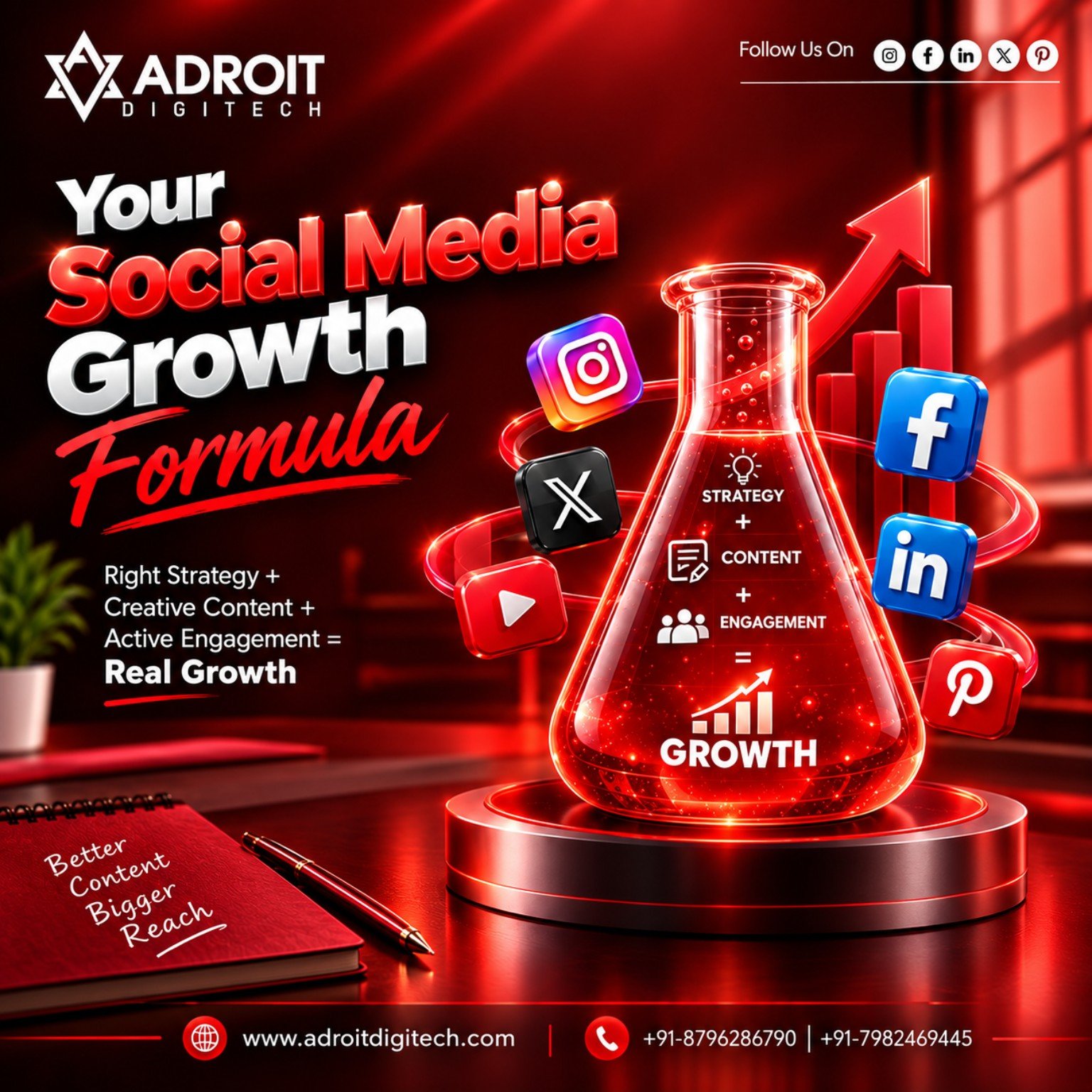
The biggest pain point: Businesses are posting on Instagram, Facebook, LinkedIn and other platforms regularly, yet they are not getting the reach, engagement, enquiries or business growth they expected. The problem is often not a lack of posting. It is the absence of a clear strategy connecting content with the right audience and active engagement.
That is exactly the story represented in the image: Strategy + Creative Content + Engagement = Growth.
Today, social media is no longer simply a place to upload a promotional poster and wait for customers. A business can have attractive creatives, a professional logo and even hundreds of posts, but if the content does not answer customer questions, create interest or encourage interaction, growth can remain slow.
For businesses in Delhi, Noida, Gurugram, Faridabad and the wider Delhi NCR market, this becomes even more important. Customers are constantly comparing businesses online before making a purchase, booking a service or sending an enquiry. Your social media presence often becomes part of that decision-making process.
The real question, therefore, is not “How often should my business post on social media?”
It is:
“Is my social media strategy actually designed to turn attention into meaningful business growth?”
What Is the Social Media Growth Formula?
A strong social media presence can be understood through three connected elements:
Right Strategy + Creative Content + Active Engagement = Real Growth
The formula shown in the image is important because removing even one of these elements can weaken the entire social media effort.
Imagine a restaurant posting beautiful food photographs every day. The content may look professional, but if the posts do not target the right local customers, communicate why the restaurant is different or encourage people to take action, the content may receive likes without generating visits or enquiries.
Now consider another business that has a good strategy but publishes the same generic promotional message repeatedly. The strategy exists, but the audience has little reason to stop scrolling.
A third business may create excellent content but never respond to comments or customer messages. The audience starts a conversation, but the business does not continue it.
This is why social media growth is not created by content alone. It is created when strategy, content and engagement work together.
Why Businesses Struggle With Social Media Growth
One of the most common mistakes businesses make is treating social media as a daily posting task.
Someone creates a post, adds a caption, publishes it and moves on to the next day.
After a few weeks, the business owner checks the numbers and asks, “Why aren’t we getting leads?”
The problem is that posting frequency does not automatically equal marketing effectiveness.
A social media page needs a purpose. Is the goal to increase brand awareness? Generate enquiries? Build trust? Drive website traffic? Educate potential customers? Promote a new service? Build a local community?
Without answering these questions first, content can become disconnected from the actual business objective.
Google’s current guidance also emphasizes creating useful, people-first content rather than producing material primarily to manipulate search rankings. That principle applies well beyond websites: content should have a genuine purpose for the audience.
Strategy Comes Before the First Post
A social media strategy is essentially the roadmap behind your content.
Before creating a reel or carousel, a business should understand who it is speaking to, what problem that audience has, what information they need and what action the business wants them to take.
For example, a digital marketing agency targeting local businesses in Delhi NCR should not publish exactly the same content as a fashion brand or a dental clinic.
A clinic may need educational content that builds credibility and answers patient questions. A restaurant may focus more heavily on food visuals, offers, location and customer experiences. A real estate business may need market insights, property walkthroughs and locality-focused content.
The platform also matters. Instagram may be useful for visual storytelling and short-form videos, while LinkedIn can be more relevant for B2B expertise and professional thought leadership.
A proper strategy brings these decisions together before content production begins.
Creative Content Is More Than a Beautiful Design
A visually attractive post can stop someone from scrolling, but visual appeal alone does not guarantee business results.
Good social media content should make the audience feel, learn, question, relate or act.
That could mean explaining a common customer problem, showing how a service works, answering a frequently asked question, demonstrating a product, sharing a behind-the-scenes process or telling a customer story.
For example, instead of a generic post saying:
“We provide digital marketing services. Contact us today.”
A stronger content idea might explain:
“Getting views but no enquiries? Here are three reasons your social media may not be converting attention into customers.”
The second idea starts with a real problem. It gives the audience a reason to read.
That is what makes content useful.
Google’s people-first content guidance similarly encourages original, substantial and useful information that leaves readers feeling they have learned enough to accomplish their goal.
Why Engagement Is the Missing Part of the Formula
Many businesses focus heavily on publishing but overlook what happens after publication.
Someone comments on your post.
Someone sends a DM.
Someone asks about your price.
Someone shares your reel.
Someone tags a colleague.
These are not just numbers. They are opportunities to continue the customer conversation.
Active engagement means responding to relevant comments, answering messages, participating in conversations and paying attention to what the audience is repeatedly asking.
Suppose a person comments, “Do you provide this service in Noida?”
If the business responds quickly and clearly, the interaction can move from a public comment toward a potential enquiry.
This is why engagement should not be treated as an optional extra. It connects content with people.
From Social Media Attention to Business Enquiries
The ultimate objective of social media will differ from business to business, but most companies eventually want attention to contribute to business outcomes.
The journey can look something like this:
Content → Attention → Engagement → Trust → Enquiry → Customer
This does not mean every post will generate a direct sale. Some content exists to introduce the brand. Other content educates. Some posts create conversations, while others provide a direct offer.
A healthy social media strategy uses different content for different stages of the customer journey.
For instance, a service business could use educational reels to attract new audiences, carousel posts to explain its expertise, testimonials to build trust and direct CTA posts to generate enquiries.
The objective is to create a complete content ecosystem rather than expecting every post to sell immediately.
What Should a Business Post on Social Media?
A useful content mix generally combines education, brand storytelling, engagement and commercial communication.
Educational content answers customer questions.
Problem-solving content addresses frustrations.
Behind-the-scenes content makes the business more human.
Case studies demonstrate experience.
Testimonials provide social proof.
Reels can explain concepts quickly or show the product/service in action.
Carousels can break complicated subjects into easily understandable sections.
Promotional posts communicate offers, packages or specific services.
The right mix depends on the business, audience and objective.
There is no universal number of posts that guarantees growth. The more important question is whether each piece of content has a clear reason for existing.
Common Social Media Mistakes That Hold Businesses Back
One major mistake is copying competitors without understanding why their content works. A competitor’s audience, positioning and customer journey may be completely different from yours.
Another problem is excessive promotional content. If every post says “Buy Now”, “Contact Us” or “Limited Offer”, the audience can quickly lose interest.
Inconsistent branding is another issue. If every post uses different colours, typography and messaging, the business can become difficult to recognize.
Businesses also sometimes focus too much on vanity metrics. Likes and followers can be useful indicators, but they do not tell the entire story. Saves, shares, comments, profile visits, website clicks, enquiries and conversions can provide more useful context depending on the objective.
Ignoring negative or unanswered comments can also damage the customer experience.
Most importantly, businesses often change their strategy too quickly. One week they focus on reels, the next on memes, then suddenly on promotional graphics. Without enough consistency to understand what is working, it becomes difficult to learn from the data.
How to Know Whether Your Social Media Is Actually Working
Social media performance should be measured against the business objective.
If the objective is awareness, reach and content discovery may matter.
If the objective is engagement, shares, comments, saves and meaningful interactions can provide useful signals.
If the objective is lead generation, enquiries, website visits, calls or form submissions become more important.
A business should therefore avoid asking only:
“How many likes did this post get?”
Instead, ask:
“What did this content help us achieve?”
There is also an increasingly useful connection between social content and Google Search. Google introduced platform properties in Search Console in 2026, allowing eligible creators and publishers to understand how content from platforms such as Instagram, TikTok, X and YouTube performs in Google Search and Discover. Search Console can show search queries associated with this content, creating another data source for future content ideas.
That means businesses should not think of their website SEO and social media content as completely isolated activities. Audience questions discovered through one channel can inform content on another.
Social Media and SEO Should Support Each Other
Social media management and SEO are different disciplines, but they can work together.
Suppose a Delhi-based interior design company discovers through social media comments that customers repeatedly ask about “budget home interiors in Delhi”.
That customer language can provide an idea for a detailed website article.
The business could then create a social post summarizing the article, publish a reel around the same question and direct interested users to the website.
The process becomes:
Customer question → Social content → Website content → Search visibility → Further discovery
Google’s current Search guidance recommends using words that people actually use to look for content and placing relevant language in meaningful locations such as titles and headings.
The goal is not to stuff keywords everywhere. It is to understand the language of the customer and communicate clearly.
Why Local Social Media Marketing Matters in Delhi NCR
For local businesses, location can be an important part of the customer decision.
A person searching for a salon, restaurant, clinic, real estate consultant, digital marketing agency or other service provider may specifically want someone nearby.
That creates opportunities for businesses serving Delhi, Noida, Gurugram, Faridabad and other Delhi NCR locations to create locally relevant content.
A restaurant can showcase its locality and nearby customer experiences. A service provider can explain the problems faced by businesses in a particular market. A real estate company can create content around specific neighbourhoods. A digital agency can discuss the online challenges commonly faced by local businesses.
The content becomes more useful because it reflects the audience’s actual environment rather than using a generic national message.
Google also notes that location can be one of the factors involved in determining relevant search results, particularly for local queries.
How to Choose the Right Social Media Marketing Solution
Before hiring a social media marketing agency, businesses should look beyond the number of posts included in a package.
Ask how the strategy will be developed.
Ask whether the agency will understand your customers and competitors.
Ask how content ideas are researched.
Ask whether the service includes community engagement.
Ask how performance will be measured.
Ask how social media activity connects with your wider digital presence.
A package offering “20 posts per month” may sound impressive, but quantity alone does not explain whether those posts will communicate the right message to the right audience.
The better question is whether the agency can build a consistent system around strategy, creative content, engagement and measurement.
How Adroit Digitech Approaches Social Media Growth
At Adroit Digitech, social media is approached as more than a content-posting exercise.
The focus is on understanding the business first, identifying its audience and then developing content around the brand’s goals. Strategy provides the direction, creative content communicates the message and active engagement helps maintain the relationship with the audience.
Depending on the business requirement, this can include social media strategy, content planning, creative posts, reels, carousel content, social media management, engagement, campaign support and broader digital marketing activities.
The advantage of this approach is that social media does not have to operate separately from the rest of a company’s digital presence. Content can support website traffic, brand visibility, customer education and enquiry generation while maintaining a consistent identity.
For businesses in Delhi and Delhi NCR, this can also mean developing content that feels relevant to the local market instead of simply recycling generic industry posts.
The goal is not to promise overnight growth. It is to build a more structured digital presence where every piece of content has a clear purpose.
A Practical Social Media Growth Framework for Your Business
If your current social media feels busy but not productive, start by reviewing the three parts of the formula.
First, look at your strategy. Can you clearly explain who your target customer is and what you want social media to achieve?
Next, examine your content. Does your page answer customer questions and communicate your expertise, or is most of the content simply promotional?
Finally, review your engagement. Are you responding to comments and DMs? Are you learning from questions people repeatedly ask? Are you creating content based on those conversations?
If one of these areas is missing, the problem may not be that you need to post more.
You may need to build a better system.
The Real Social Media Growth Formula
The message behind the image is simple, but it addresses a problem many businesses experience every day:
Strategy without content cannot communicate.
Content without strategy can become noise.
Content without engagement can become a one-way conversation.
Real social media growth requires all three working together.
A business does not need to be present on every platform simply because competitors are there. It needs to understand where its audience spends time, what that audience wants to know, what problems the business can solve and how those conversations can contribute to larger business goals.
And as social and video content becomes increasingly discoverable through Google, businesses have another reason to create content that is useful, specific and genuinely relevant to their audience.
If your business is posting regularly but the results are not matching the effort, it may be time to stop asking “What should we post today?”
Start asking:
“What should our audience see, understand and do next?”
That shift—from posting content to building a strategy—is where social media becomes a real business-growth channel.
FAQs
What is the best social media growth strategy for a business?
A practical social media growth strategy combines a clear target audience, defined business objectives, useful content, consistent branding, active engagement and regular performance analysis. The exact approach depends on the industry and customer journey.
Why is my business social media not generating leads?
Common reasons include unclear targeting, generic content, excessive promotional posts, weak CTAs, inconsistent communication and limited engagement with the audience. A page can receive visibility without necessarily creating enough trust or motivation for someone to enquire.
How often should a business post on social media?
There is no universal posting frequency that guarantees growth. Consistency and relevance are more important than simply increasing volume. The business should choose a sustainable publishing schedule that allows enough time for quality content, engagement and performance analysis.
Is social media important for local businesses in Delhi NCR?
Yes, social media can help local businesses communicate with nearby audiences, demonstrate expertise, showcase products or services and build familiarity before a potential customer contacts them. Local relevance should be incorporated naturally rather than repeatedly inserting location keywords.
Does social media help SEO?
Social media and SEO are separate marketing activities, but they can support each other. Social content can help audiences discover a brand and can provide useful insights into customer questions and topics. Google now also provides Search Console functionality for understanding how certain social and video platform content performs in Google Search.
Should I hire a social media marketing agency?
Businesses can manage social media internally, but an agency can be useful when the business needs strategic planning, regular content production, creative development, engagement management and performance analysis without building the entire team internally. Before choosing an agency, evaluate its process rather than judging the service only by the number of posts promised.
What should a social media marketing agency provide?
Depending on the business, the service may include strategy, content calendars, copywriting, graphic design, reels, carousel posts, community management, campaign planning, reporting and coordination with other digital marketing activities.
How can I improve my social media engagement?
Start by creating content around genuine customer questions and problems. Use formats that encourage discussion, respond to relevant comments and messages, and analyse which topics generate meaningful interactions. Engagement should be treated as an ongoing conversation rather than a number to chase.
