




A business can spend thousands on advertising and still struggle to generate quality enquiries.
The problem is not always the ad creative, the offer or even the advertising budget. Sometimes, the real problem is much simpler: the advertisement is reaching people who are in the wrong place.
A local business operating in Delhi may receive clicks from users who live outside its service area. A clinic may attract enquiries from people too far away to visit. A home-service company may pay for traffic from locations where it does not provide services.
These clicks may increase traffic numbers, but they do not necessarily increase business.
That is why location-based ads matter.
The principle is straightforward:
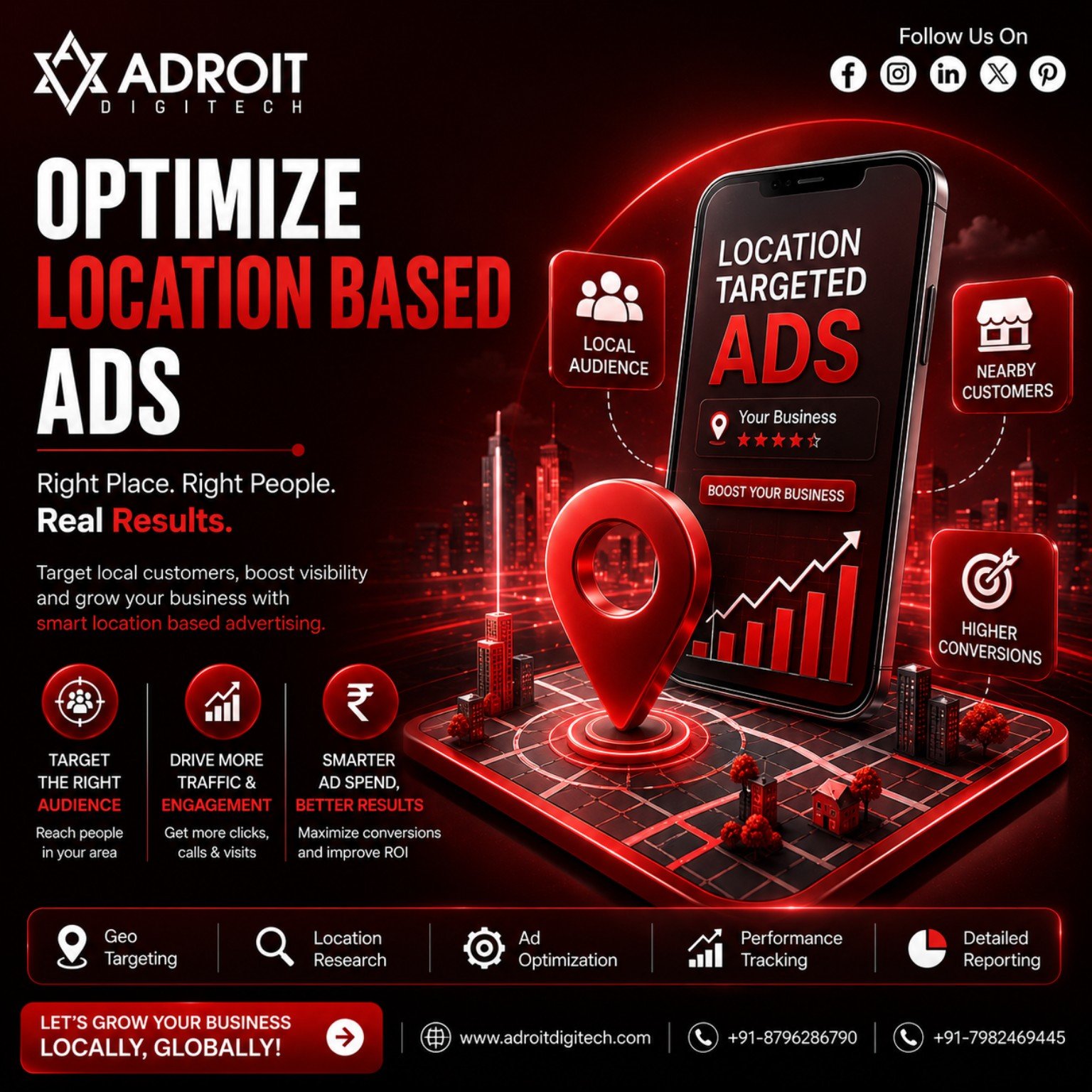
Right Place. Right people. Real Results.
Instead of trying to reach everyone, businesses can focus advertising on the geographic areas where their potential customers actually live, work, shop or search for services.
For businesses operating in Delhi and Delhi NCR, this approach becomes even more important because different areas can represent very different customer markets. Effective location targeting can help businesses make their advertising more relevant, improve budget efficiency and focus on actions that matter—such as calls, enquiries, bookings, visits and sales.
What Are Location-Based Ads?
Location-based ads are digital advertisements shown to audiences according to geographic targeting criteria.
Depending on the advertising platform and campaign setup, businesses can target specific cities, regions, areas, locations or geographic segments.
For example, a business may want to reach customers in:
- Delhi
- Noida
- Gurugram
- Ghaziabad
- Faridabad
- Specific neighbourhoods
- Areas surrounding a physical location
- Defined service areas
The purpose is not simply to make an advertising audience smaller.
The purpose is to make it more commercially relevant.
Consider a digital marketing agency that primarily works with businesses in Delhi NCR. Advertising to users across the entire country may generate considerable traffic, but much of that audience may not be relevant to the agency’s local sales strategy.
A carefully planned local campaign can instead focus on the locations that align with the company’s business objectives.
Why Location Targeting Can Make or Break a Local Advertising Campaign
Imagine two businesses with the same advertising budget.
Business A shows its advertisement to a very broad audience.
Business B concentrates its campaign on carefully selected service areas.
Business A might generate more impressions and clicks.
But Business B may generate more relevant enquiries.
This is an important distinction.
Advertising success should not be judged only by how many people see an advertisement. For many local businesses, the more important question is:
How many people who can actually become customers are taking action?
A customer who is located within your service area has obvious commercial relevance. Someone who cannot access your service may have very little value, regardless of how attractive the advertisement looks.
This is why geo-targeting should be connected to the actual business model, customer journey and service coverage.
The Local Customer Problem: Visibility Without Relevance
Many businesses focus heavily on increasing visibility.
They want:
- More impressions
- More clicks
- More website visitors
- More engagement
Those metrics can be useful, but they do not tell the complete story.
Suppose a local service company receives 500 clicks from an advertising campaign.
Sounds good.
Now imagine that 300 of those visitors are outside the company’s service area.
The campaign generated traffic, but a large part of that traffic cannot realistically become customers.
This creates a hidden advertising problem: the business is paying for attention that has limited commercial value.
Location optimisation addresses this problem by bringing geography into the advertising strategy.
Instead of asking:
“How many people can we reach?”
The business starts asking:
“Where are the people we actually want to reach?”
That shift can completely change how a campaign is planned and evaluated.
Local Audience: Start With the People You Can Actually Serve
The first step in location-based advertising is not opening an advertising dashboard.
It is understanding your service area.
Ask yourself:
Where do my customers come from?
Where can my team provide the service?
How far are customers realistically willing to travel?
Which locations have already generated enquiries or sales?
Are there areas where demand is strong but our advertising presence is weak?
These questions help create a practical geographic strategy.
For example, a dental clinic may focus on customers living or working relatively close to the clinic. A restaurant may depend heavily on nearby customers. A home-cleaning company may define a specific service radius. A real estate company may need to target several areas where it handles properties.
The correct targeting strategy therefore depends on the business.
There is no universal rule saying that every company should target an entire city or an entire NCR region.
Geo Targeting: Choosing the Right Locations
Once the service area is understood, the next step is geo-targeting.
Geo-targeting means defining the geographic audience that an advertising campaign is intended to reach.
However, simply selecting a location does not automatically create an effective campaign.
Location selection should be supported by research.
A business can analyse:
- Existing customer locations
- Lead quality
- Conversion data
- Website enquiries
- Call activity
- Sales performance
- Customer value
- Service availability
- Competition
- Advertising costs
This creates a much stronger foundation for campaign decisions.
For example, suppose a business targets five areas across Delhi NCR.
After several weeks of meaningful campaign data, it discovers that two locations generate highly relevant enquiries, one generates inexpensive but low-quality clicks, and another generates very little activity.
The answer is not necessarily to remove everything immediately.
The business should investigate the reasons behind the difference.
This is where location research and performance tracking become important.
Right Place, Right People: Why Relevance Matters More Than Reach
The central message of the campaign shown in the image is powerful:
Right Place. Right people. Real Results.
The first two parts are connected.
Being in the right place means reaching a geographic market that makes sense.
Reaching the right people means attracting an audience that has a realistic possibility of becoming a customer.
Only then does the third part—real results—become meaningful.
For example, a local fashion store does not necessarily need nationwide advertising to generate local store visits.
A coaching centre may want students and parents within relevant nearby areas.
A home-repair business may need customers within its operational service radius.
A digital marketing agency may want businesses in selected Delhi NCR markets.
The advertising strategy should follow the customer journey rather than simply maximise audience size.
How to Optimize Location-Based Ads
1. Define Your Business’s Service Area
Start with your operational reality.
If you provide services only in selected parts of Delhi NCR, your advertising strategy should reflect that.
Do not target locations simply because they have a large population.
Target locations because they have business relevance.
2. Research Your Existing Customers
Your existing customers can provide valuable clues.
Look for patterns in:
- Customer addresses or service areas
- Lead sources
- Conversion locations
- High-value customers
- Repeat customers
- Enquiry volume
If a particular location consistently produces valuable customers, it deserves closer attention.
3. Build Logical Campaign Segments
If your business operates across multiple markets, consider whether those locations should be analysed separately.
For example, Delhi and Noida may both be part of NCR, but customer behaviour, competition and commercial conditions can differ.
Separating important geographic segments can make performance easier to understand.
4. Match the Ad Message With Local Intent
Location targeting becomes more powerful when the advertisement itself is relevant.
Instead of using a completely generic message, businesses can communicate the service and location clearly where appropriate.
For example:
“Digital Marketing Services for Delhi NCR Businesses”
can communicate local relevance more clearly than an overly broad message.
However, local keywords should never be inserted unnaturally simply for SEO or advertising purposes.
The message should sound like something a real customer would find useful.
5. Optimise the Landing Page
A targeted advertisement can bring the right visitor to a website, but the website still needs to convert that visitor.
The landing page should make important information easy to understand:
- What service is offered?
- Who is it for?
- Which areas are served?
- What makes the business credible?
- How can the customer contact the business?
- What action should the visitor take?
If a local customer clicks an ad and cannot quickly understand whether the business serves their area, an opportunity may be lost.
6. Track Meaningful Conversions
A campaign should not be evaluated only through clicks.
For a local business, valuable conversion actions may include:
Phone calls → Form submissions → WhatsApp enquiries → Bookings → Store visits → Purchases
The exact conversion depends on the business.
A professional advertising strategy should therefore connect campaign activity with meaningful business outcomes.
Smarter Ad Spend: Where Should Your Budget Go?
One of the most important benefits of location optimisation is better decision-making around advertising spend.
This does not mean that geographic targeting automatically guarantees lower costs.
Instead, it can help businesses identify where advertising exposure is more relevant and where budget may deserve greater or lower priority.
Consider this example:
A campaign spends ₹30,000 across several geographic locations.
Location A generates 100 clicks and 3 qualified enquiries.
Location B generates 70 clicks and 12 qualified enquiries.
Location C generates 120 clicks but almost no meaningful leads.
If the business only looks at clicks, Location C appears successful.
If it looks at business outcomes, the conclusion can be completely different.
This is why smarter ad spend is about quality, not just quantity.
Higher Conversions Start With Better Targeting
Location targeting alone cannot guarantee higher conversions.
A successful conversion depends on multiple factors:
Targeting + Offer + Ad Creative + Landing Page + Trust + User Experience + Conversion Tracking
However, relevant geographic targeting can create better conditions for conversion by bringing more appropriate users into the campaign.
For example, someone searching for a service near their location may have a stronger practical reason to enquire than someone who cannot access that service.
The objective is therefore not to promise instant results from location targeting.
The objective is to build an advertising system where the audience, message and conversion journey are aligned.
Performance Tracking: The Step Many Businesses Ignore
A campaign cannot be properly optimised without data.
The image highlights performance tracking and detailed reporting for an important reason.
After launching a location-targeted campaign, businesses should monitor how different geographic segments perform.
Important metrics may include:
- Impressions
- Click-through rate
- Cost per click
- Leads
- Conversion rate
- Cost per lead
- Calls
- Qualified enquiries
- Sales
- Return on advertising spend
But numbers should always be interpreted in context.
A location generating ten leads is not necessarily better than a location generating five leads if those five leads are significantly more valuable.
Lead quality matters.
Common Location-Based Advertising Mistakes
Targeting the Entire NCR Without a Strategy
Delhi NCR is a large and diverse market.
Simply targeting the whole region without understanding service coverage can create unnecessary advertising exposure.
Choosing Locations Based Only on Population
A large population does not automatically mean high demand for your particular product or service.
Measuring Only Clicks
Cheap clicks can look attractive while producing very few qualified enquiries.
Ignoring Service Limitations
If your company cannot serve a particular location effectively, advertising heavily there may create poor customer experiences.
Using One Generic Message Everywhere
Different audiences can respond to different needs and motivations.
Forgetting Conversion Tracking
Without proper tracking, it becomes difficult to determine which locations are actually contributing to business growth.
Changing Campaigns Too Frequently
Optimisation should be data-driven. Reacting to every short-term fluctuation can make campaign performance harder to interpret.
How to Choose the Right Location-Based Advertising Solution
Before selecting an agency or advertising professional, ask how they approach location targeting.
A strong strategy should not begin with:
“How much advertising budget do you have?”
It should begin with:
“Who are your customers, where are they located, and where can your business serve them?”
Look for a team that understands:
- Geographic targeting
- Local audience research
- Campaign structure
- Ad copy
- Landing-page experience
- Conversion tracking
- Performance analysis
- Budget optimisation
- Reporting
The right partner should be able to explain why specific locations are being targeted, not simply add locations to a campaign.
How Adroit Digitech Approaches Location-Based Advertising
For businesses that want to reach customers more strategically, Adroit Digitech can support the complete location-based advertising process.
The approach represented in the image focuses on five important areas:
Geo Targeting
Identify and structure relevant geographic areas according to the business’s actual service coverage and customer market.
Location Research
Study the target market and campaign data to understand where opportunities and problems exist.
Ad Optimisation
Continuously evaluate targeting, messaging and campaign performance instead of treating advertising as a one-time setup.
Performance Tracking
Monitor meaningful campaign actions and location-level performance.
Detailed Reporting
Turn campaign data into understandable insights so businesses can make informed decisions about their advertising strategy.
This approach keeps the focus on the complete journey:
Local Audience → Relevant Targeting → Better Traffic → Qualified Enquiries → Measurable Results
For businesses in Delhi and Delhi NCR, this can be particularly valuable when geographic relevance plays a major role in customer acquisition.
Location-Based Advertising in Delhi & Delhi NCR
Delhi NCR should not always be treated as one single advertising market.
A business targeting Rohini may have different customer behaviour from one targeting Saket. A company serving Noida may need a different approach from a business primarily operating in Gurugram.
Even within the same city, the most valuable audience can vary according to the product, service, price point and customer profile.
That is why local advertising in Delhi NCR should be based on business-specific geographic research, rather than simply adding every nearby location.
For a local business, the strongest strategy is often to start with realistic service areas, collect meaningful campaign data and then refine the geographic targeting according to actual performance.
A Simple Framework for Better Local Advertising
If your business wants to improve location-based advertising, use this framework:
1. Define
Identify exactly where you can serve customers.
2. Research
Understand where your existing and potential customers are located.
3. Target
Build geographic targeting around commercially relevant areas.
4. Communicate
Create advertising messages that clearly match customer intent.
5. Convert
Make the landing page and enquiry process simple.
6. Track
Measure calls, enquiries, leads, sales and other meaningful actions.
7. Optimise
Use performance data to improve targeting and advertising efficiency.
8. Report
Understand what is working, what is not and where the next opportunity lies.
This is how a location-based advertising campaign becomes an ongoing growth strategy rather than simply another paid advertising activity.
Frequently Asked Questions
What are location-based ads?
Location-based ads are digital advertisements targeted toward people in selected geographic areas. They are particularly useful for businesses that serve specific cities, neighbourhoods or service regions.
Is location targeting useful for small businesses?
Yes. Small and local businesses can benefit from focusing advertising on areas where they can realistically serve customers instead of spending their entire budget on a broad audience.
How does geo-targeting work?
Geo-targeting uses geographic criteria to determine where advertisements should be shown. The available targeting options depend on the advertising platform and campaign type.
Should a business target the whole of Delhi NCR?
Not necessarily. The appropriate targeting area depends on your service coverage, customer profile, business model and campaign objectives.
Can location-based ads reduce wasted advertising spend?
Relevant geographic targeting can help reduce exposure to audiences that are unlikely to become customers. However, overall advertising efficiency also depends on creative quality, bidding, competition, landing pages and conversion performance.
Can location targeting increase conversions?
It can improve audience relevance and create better conditions for conversions, but it does not guarantee higher conversion rates by itself. The complete advertising and customer journey must work together.
How do I know which location is performing best?
Compare locations using meaningful business metrics such as qualified leads, conversion rate, cost per lead, calls, sales and customer value—not clicks alone.
Are location-based ads suitable for Delhi NCR businesses?
They can be highly relevant for businesses whose customers are concentrated in particular Delhi NCR markets. The strategy should be customised according to the actual service area and target audience.
What should I track in a location-based advertising campaign?
Track metrics such as traffic, leads, calls, enquiries, conversions, cost per conversion and location-wise performance. The most important metrics depend on your business objective.
Final Thoughts
Successful local advertising is not about reaching the maximum number of people.
It is about reaching the right people in the right places with the right message.
When businesses understand their service areas, research their local audience, use appropriate geo-targeting, track meaningful conversions and continuously optimise campaign performance, advertising becomes much more strategic.
The message is simple:
Right Place. Right people. Real Results.
If your current campaigns are generating clicks but not enough local enquiries, the problem may not be your advertising budget. Your location strategy may need a closer look.
Adroit Digitech can help you plan, manage and optimise location-based advertising campaigns focused on relevant audiences, smarter ad spend and measurable business outcomes across Delhi and Delhi NCR.
Ready to reach more of the customers who actually matter?
Let’s grow your business locally and globally.
