



There is a frustrating moment almost every business owner experiences: you are posting regularly, running advertisements, maintaining a website and trying to stay active on social media, yet the phone is not ringing as much as you expected. Website traffic may look acceptable in analytics, but qualified leads are missing. Social media may have followers, but engagement does not translate into customers. And every month, marketing expenses continue while the question remains the same: “What are we actually getting from our digital marketing?”
That is exactly where digital marketing in 2026 is changing the conversation.
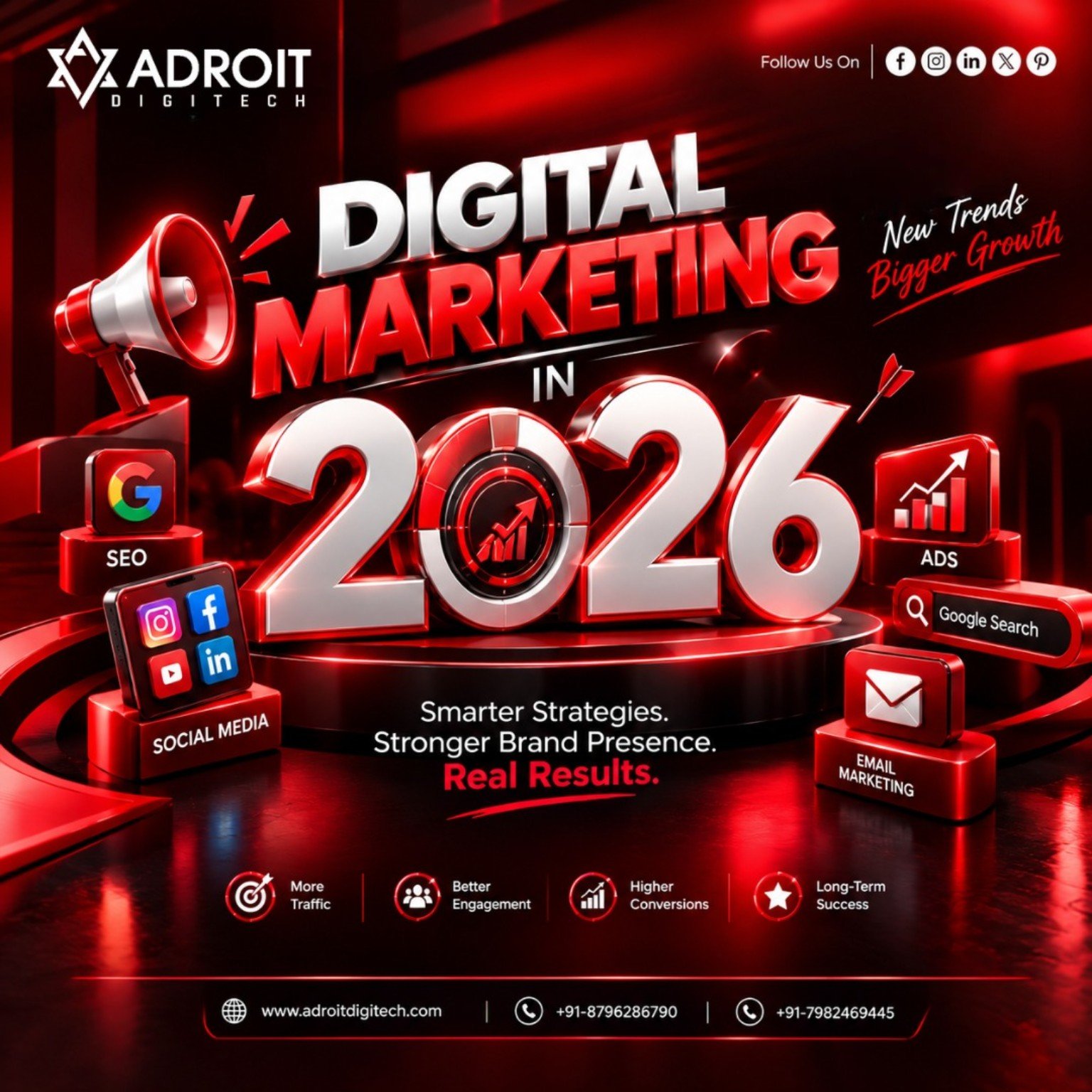
The goal is no longer simply to “be online.” Businesses need to become discoverable, credible, engaging and measurable across the digital channels where customers make decisions. The visual message behind the “Digital Marketing in 2026” concept is simple but important: smarter strategies should create a stronger brand presence and, ultimately, real results—more traffic, better engagement, higher conversions and long-term business growth.
Google itself continues to emphasize people-first, useful and reliable content rather than content created primarily to manipulate rankings. Its current guidance also makes clear that SEO is about helping search engines understand a website while helping users find and evaluate it.
For businesses in Delhi, Delhi NCR and other competitive markets, this shift matters even more. Customers have more choices, search results are becoming more sophisticated, advertising is increasingly automated, and a business cannot depend on a single marketing channel anymore.
Why Digital Marketing in 2026 Is Different
A few years ago, digital marketing could be approached as a collection of separate activities: SEO for Google, social media for awareness, Google Ads for leads and email marketing for existing customers. Today, these activities increasingly influence one another.
A customer might discover a brand through Instagram, search its name on Google, visit its website, read reviews, compare competitors, watch a video and only then submit an enquiry. Another customer may search directly for a service, see a Google advertisement, visit a landing page and call within minutes.
This means that successful digital marketing is less about asking, “Which platform should we use?” and more about asking, “What journey does our customer take before becoming a customer?”
That shift is particularly important for service businesses. A beautiful social media feed cannot compensate for poor search visibility. A high Google ranking cannot compensate for an unconvincing website. And an advertising campaign cannot remain profitable if conversion tracking is inaccurate or the landing experience is weak.
The stronger approach is an integrated digital strategy where SEO, paid advertising, social media and email marketing support the same business objective.
The Real Problem: Visibility Without Business Results
One of the biggest mistakes businesses make is confusing digital activity with digital growth.
A company may publish ten social media posts every month and still generate very few enquiries. Another may spend heavily on Google Ads but attract people who are not ready to buy. A website may receive visitors but fail to communicate its value quickly enough.
The problem is usually not a lack of effort. It is a lack of alignment.
Imagine a Delhi-based interior design company. Its Instagram page looks professional, but when a potential customer searches for “interior designer in Delhi,” the company is difficult to find. At the same time, its Google Ads campaign sends users to a generic homepage instead of a service-specific landing page. Even if the advertisement gets clicks, the customer has to search through the website to understand what the company actually offers.
That is wasted opportunity.
A smarter strategy would connect the customer’s search intent, advertisement, landing page, social proof and follow-up process. The objective is not simply to generate traffic. It is to generate the right traffic and make it easier for that traffic to convert.
SEO in 2026: Be Useful Before Trying to Rank
SEO remains one of the most important foundations of digital marketing, but the way businesses should approach it has evolved.
Google recommends creating helpful, reliable, people-first content and specifically warns against producing content primarily to attract search-engine traffic. It also recommends using the words people actually search for in important places such as page titles and headings while ensuring the content genuinely helps users.
That means a business should not create an article simply because a keyword has search volume.
Instead, start with the customer.
If people search for “best digital marketing agency in Delhi,” they may actually want to know how to compare agencies, what services they should expect, how pricing works, what results are realistic and how to avoid wasting their advertising budget.
A useful SEO page should answer those questions.
This is also why long-form content, service pages, location pages, case studies, FAQs and genuinely useful resources can work together as part of a broader search strategy. The objective is to establish topical relevance and demonstrate that the business understands the customer’s problem.
Google’s documentation also notes that its systems can understand related variations of a search query, so businesses do not need to force every possible keyword variation into a page.
Google Search Is Becoming More Conversational
Search behaviour is changing as people increasingly ask more detailed and conversational questions. Google’s 2026 Search documentation updates include guidance around generative AI features in Search, with emphasis on useful, non-commodity information as well as local, shopping, image and video content. Google also states that established SEO fundamentals remain relevant for these newer search experiences.
For businesses, the practical lesson is straightforward: write for questions, not just keywords.
Instead of targeting only “digital marketing agency Delhi,” a business can create useful content around questions such as:
“What does a digital marketing agency actually do?”
“How much does digital marketing cost for a small business?”
“How can a local business get more leads from Google?”
“What is the difference between SEO and Google Ads?”
“How long does SEO take to generate results?”
These topics naturally address informational and commercial search intent while giving potential customers a reason to trust the business.
Google Ads: Faster Visibility, but Measurement Matters
SEO can take time. Paid advertising can provide faster visibility, which makes Google Ads an important part of a balanced digital marketing strategy.
But advertising should not be treated as simply “put money into Google and wait for leads.”
Modern Google Ads campaigns increasingly rely on automation, conversion signals, audience information, creative assets and business goals. Google’s current Performance Max guidance recommends accurate conversion tracking, strong assets and relevant audience signals because these inputs help Google’s systems optimize campaigns toward business outcomes.
This changes what good campaign management looks like.
A business should know whether it wants phone calls, qualified enquiries, purchases, appointments, registrations or another measurable action. Without that clarity, an advertising campaign may generate impressive-looking numbers without producing meaningful business value.
For example, 500 clicks sound positive until you discover that only two people contacted the business. Conversely, 100 highly relevant visitors who generate 15 qualified enquiries may be considerably more valuable.
The metric that matters is not always traffic. It is what traffic does next.
Social Media: From Posting to Building Brand Memory
The social media element in the image represents another important part of the 2026 digital marketing ecosystem.
Instagram, Facebook and LinkedIn are not merely platforms for publishing promotional graphics. They are places where customers form an impression of a business before contacting it.
A potential customer may visit a company’s profile after seeing its Google listing. If the profile looks inactive, repetitive or unclear, trust can disappear quickly. On the other hand, useful educational posts, customer stories, behind-the-scenes content, expert opinions and well-produced visual content can make a brand feel established and credible.
The objective of social media should therefore be broader than follower growth.
Good social media marketing should help answer three questions:
Does this brand understand my problem?
Can I trust this brand?
Why should I choose this brand instead of another option?
That is where consistent content strategy becomes more valuable than simply increasing the number of posts.
Email Marketing Still Has a Role in 2026
The email marketing element shown in the image may look less visually dominant than SEO, social media or advertising, but it can be extremely useful for businesses that already have an audience.
Someone who has previously contacted your company, downloaded a resource, requested information or purchased from you should not necessarily disappear from your marketing system after one interaction.
Email can be used to educate prospects, share useful information, introduce services, announce offers, nurture leads and encourage repeat purchases.
The important distinction is relevance.
Sending the same promotional email to everyone is unlikely to create a strong customer experience. Segmenting audiences based on interests, previous actions or customer stage can make communication considerably more useful.
In other words, social media may help you get attention, SEO may help people discover you, advertising may help you reach high-intent audiences, and email can help maintain the relationship.
The Four Outcomes Every Digital Strategy Should Work Toward
The message in the visual can be translated into four practical business outcomes.
More Traffic
Your website needs qualified visitors from relevant searches, advertisements, social platforms, referrals and other channels. More traffic alone is not enough, but without relevant visibility, growth becomes difficult.
Better Engagement
People should have a reason to interact with your brand. Useful content, strong creative, clear messaging and relevant offers can turn passive viewers into active prospects.
Higher Conversions
Traffic and engagement ultimately need to support business goals. This could mean calls, forms, bookings, purchases, WhatsApp enquiries or another meaningful conversion.
Long-Term Success
The strongest digital strategy is not built around one viral post or one successful advertisement. It creates assets that continue working: useful content, search visibility, brand recognition, customer relationships and reliable measurement.
That is why digital marketing should be viewed as a long-term growth system rather than a collection of monthly posts.
Common Digital Marketing Mistakes Businesses Should Avoid
One common mistake is trying to be present everywhere without having a clear strategy. A small business does not necessarily need to dominate every social platform. It needs to understand where its customers actually spend time and where they search for its services.
Another mistake is focusing entirely on vanity metrics. Followers, impressions and clicks can provide useful information, but they do not automatically represent revenue.
A third mistake is treating SEO as a keyword-insertion exercise. Repeating “digital marketing agency Delhi” throughout a page will not transform weak content into valuable content. Google explicitly promotes helpful, reliable, people-first content rather than search-engine-first material.
Businesses also frequently launch Google Ads without properly configuring conversion tracking. That makes it difficult to understand which campaigns, audiences or assets are genuinely contributing to business outcomes. Google recommends accurate conversion measurement as an important part of Performance Max campaign management.
Finally, many businesses change strategies too quickly. SEO, content and advertising data require enough time and context to evaluate properly. Constantly changing campaigns before meaningful patterns emerge can make optimization more difficult.
How to Choose the Right Digital Marketing Solution
Choosing a digital marketing agency should not start with the question, “How many posts will you give us?”
Start with the business objective.
If your primary challenge is poor Google visibility, SEO and local search may require greater attention. If you need immediate lead generation, Google Ads could play a larger role. If customers know your category but do not recognize your brand, social media and content may be important. If you already have a large customer database, email marketing may create additional opportunities.
A good digital marketing partner should therefore begin with an audit and discussion about the business—not simply present a package.
Ask how success will be measured. Ask what happens after a lead arrives. Ask whether reporting will connect marketing activity with actual business outcomes. Most importantly, ask whether the strategy is designed around your customers or simply around producing content every month.
Why Local Digital Marketing Matters in Delhi and Delhi NCR
For many businesses, location is part of the search intent.
Someone searching for a service in Delhi may have very different expectations from someone searching nationally. A customer in Noida, Gurugram, Faridabad or another part of the NCR region may also prefer businesses that understand the local market and customer behaviour.
Local SEO therefore becomes an important part of digital marketing for location-dependent businesses.
Google says local search results are primarily influenced by relevance, distance and prominence. Complete and accurate Business Profile information helps Google understand how a business matches relevant searches, while prominence can be influenced by factors such as reviews and links from other websites.
This means local visibility is not achieved simply by adding “Delhi” to every sentence.
A stronger local strategy can include an optimized Google Business Profile, accurate business information, useful location-specific website content, authentic reviews, locally relevant content and a consistent online presence.
For businesses serving Delhi NCR, this approach can help connect digital visibility with the customers who are actually capable of becoming customers.
Where Adroit Digitech Fits Into the 2026 Growth Story
The visual represents Adroit Digitech around four core digital marketing areas: SEO, social media, advertising and email marketing. That combination reflects an important principle of modern digital growth: businesses rarely need one isolated tactic; they need different channels working toward the same objective.
For a business that wants stronger Google visibility, the process can begin with understanding its current search presence, website content, local visibility and customer search behaviour. From there, SEO can support organic discovery while paid campaigns can target relevant high-intent audiences.
Social media can reinforce the brand message and build familiarity, while email marketing can help nurture people who are already interested in the business.
The real value comes from connecting these activities rather than operating them as separate departments.
For a company operating in Delhi or the wider NCR market, that integrated approach can be especially useful because competition is high and customers can compare multiple providers before making a decision.
The objective should always come back to the message in the image: smarter strategies, stronger brand presence and real results.
A Practical Digital Marketing Roadmap for 2026
A business starting or restructuring its digital marketing strategy can begin with a simple sequence.
First, identify the most important commercial objective. Is it more qualified leads, online sales, appointments, local enquiries or brand visibility?
Next, understand how customers currently find the business. Review Google Search visibility, Google Business Profile performance, website traffic, social media activity and paid advertising.
Then identify the gaps. Perhaps the website is difficult to navigate. Perhaps important service pages are missing. Perhaps competitors dominate local searches. Perhaps advertisements receive clicks but generate few enquiries.
After that, build the strategy around those gaps rather than blindly following trends.
SEO can establish long-term organic visibility. Google Ads can capture high-intent demand. Social media can strengthen brand recognition and engagement. Email can nurture existing prospects and customers.
Finally, measure what matters. Traffic, engagement and reach are useful indicators, but the business should also monitor leads, conversion rate, cost per lead, qualified enquiries, sales and return on marketing investment.
That is how digital marketing moves from “activity” to a measurable growth system.
Frequently Asked Questions About Digital Marketing in 2026
What is the most important digital marketing strategy in 2026?
There is no single strategy that works for every business. A strong 2026 strategy combines useful SEO content, search visibility, paid advertising where appropriate, social media, conversion-focused websites and measurable customer journeys. The right mix depends on the business model, audience and commercial objectives.
Is SEO still important in 2026?
Yes. Google continues to recommend people-first content and SEO practices that help search engines understand useful content. SEO is particularly valuable for businesses that want sustainable organic visibility rather than depending entirely on paid traffic.
Should a business invest in SEO or Google Ads?
In many cases, the two can complement each other. Google Ads can provide faster visibility for relevant searches, while SEO can build organic visibility over time. The right balance depends on competition, budget, business goals and how quickly leads or sales are required.
How can a local business improve its Google visibility?
Start with accurate and complete Business Profile information, relevant website content, strong customer reviews, consistent business information and a useful local SEO strategy. Google states that local rankings primarily consider relevance, distance and prominence.
Is social media necessary for every business?
Not every business needs to use every social platform. However, a professional and relevant social presence can support brand credibility, customer engagement and discovery. The important question is whether the chosen platform reaches the business’s actual audience.
How do I know whether my digital marketing is working?
Look beyond impressions and followers. Track meaningful actions such as qualified leads, phone calls, enquiries, bookings, purchases, conversion rates and cost per acquisition. Proper conversion tracking is particularly important for paid advertising because it helps campaigns optimize toward actual business outcomes.
What should I look for in a digital marketing agency in Delhi NCR?
Look for an agency that understands your business model, defines measurable objectives, explains its strategy clearly, provides transparent reporting and connects marketing activity to business outcomes. A good agency should be able to explain not only what it will do, but why it will do it and how success will be measured.
Final Takeaway
Digital marketing in 2026 is not about doing more marketing. It is about doing smarter marketing.
The businesses that stand out will not necessarily be the ones posting the most, spending the most or chasing every new trend. They will be the ones that understand their customers, create useful experiences, appear where people are searching, communicate consistently and measure whether their efforts are producing meaningful results.
SEO can bring qualified organic visibility. Google Ads can capture immediate search demand. Social media can build familiarity and engagement. Email can strengthen customer relationships. A well-structured website can turn attention into action.
When these pieces work together, digital marketing becomes more than promotion. It becomes a system for building traffic, trust, conversions and long-term brand growth.
And that is the real meaning behind the message: Smarter Strategies. Stronger Brand Presence. Real Results.
Ready to make your digital marketing more strategic in 2026? Connect with Adroit Digitech to build an integrated strategy around SEO, social media, Google Ads and digital growth for your business.

This is really interesting, You’re a very skilled blogger. I have joined your rss feed and look forward to seeking more of your magnificent post. Also, I have shared your website in my social networks!