



Maximize ROI with Pay-Per-Click Advertising: A Practical Guide for Delhi Businesses
You can spend ₹10,000, ₹50,000 or even ₹1 lakh on online advertising and still wonder where the money went.
The clicks came. The impressions looked impressive. The campaign dashboard showed activity. But the phone did not ring enough, enquiries were weak, and actual sales did not justify the advertising spend.
That is the real problem with poorly managed Pay-Per-Click advertising.
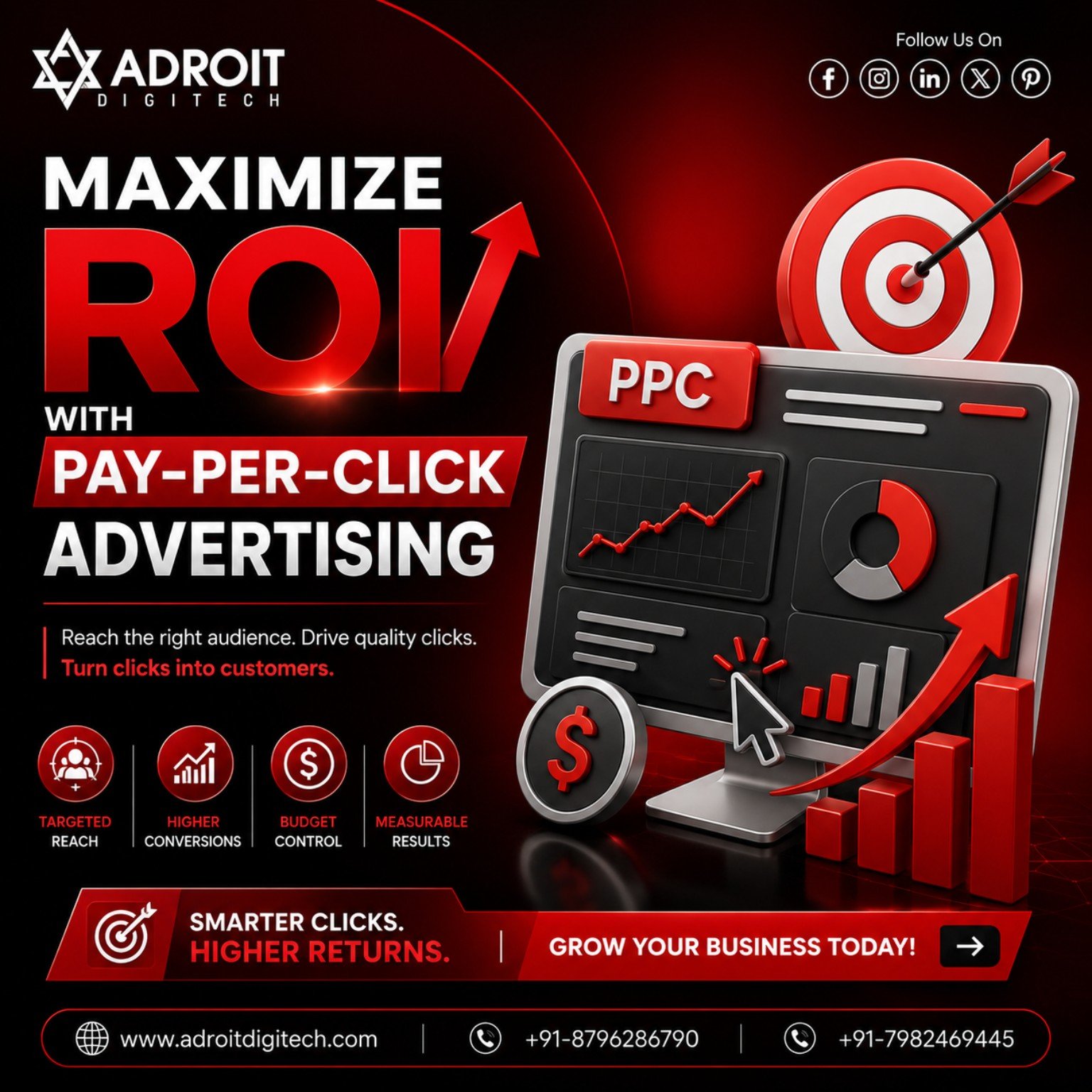
The goal of PPC is not simply to generate more clicks. The goal is to attract the right audience, control advertising costs, generate meaningful conversions and turn those conversions into profitable business opportunities. This is exactly the message represented in the image: targeted reach, higher conversions, budget control, measurable results and ultimately smarter clicks with higher returns.
For businesses competing in Delhi and Delhi NCR, where customers have countless options and competitors are actively investing in digital advertising, a properly planned PPC campaign can put your business in front of potential customers when they are actively looking for what you offer.
But getting that result requires much more than pressing the “Publish” button.
Why Businesses Spend on PPC but Still Struggle to Generate ROI
Imagine a Delhi-based business offering website development services.
The company launches a Google Ads campaign for “website development”. Within a few days, the campaign receives hundreds of impressions and several clicks. The business owner sees traffic increasing and assumes the campaign is working.
Then reality arrives.
Some visitors are looking for jobs. Others are students searching for information. Some are looking for extremely cheap services. A few may be outside the actual service area. Others visit the website but leave without submitting an enquiry.
The business has paid for traffic, but not necessarily for valuable customers.
This is where the difference between running advertisements and managing PPC advertising becomes important.
Google Ads uses an ad auction whenever eligible ads can appear. Ad Rank helps determine whether an ad is eligible and where it may appear.
Therefore, simply increasing your bid or advertising budget does not automatically guarantee profitable results. Campaign structure, targeting, keywords, ad relevance, landing-page experience, conversion tracking and bidding strategy all influence how effectively your advertising investment works.
What Is Pay-Per-Click Advertising and How Does It Work?
Pay-Per- Click advertising, commonly called PPC, is an online advertising model where advertisers can pay based on clicks on their advertisements. Google describes CPC bidding as paying for each click, with the actual cost potentially being lower than the maximum CPC bid depending on the auction.
In practical business terms, PPC allows you to place your business in front of people searching for relevant products or services.
For example, someone in Noida may search for “Google Ads agency near me”. A business offering Google Ads management can use a properly targeted search campaign to compete for visibility when that search happens.
The important word here is relevant.
If your campaign attracts 1,000 random visitors but only two are potential customers, the traffic number looks good, but the business result is poor. On the other hand, 100 highly relevant visitors who understand your offer and are ready to contact you can be much more valuable.
That is why effective PPC advertising focuses on quality clicks rather than simply more clicks.
Why ROI Should Matter More Than Clicks
Clicks are only one stage of the customer journey.
A serious PPC campaign should ask what happens after the click.
Does the visitor call your business?
Does the person submit an enquiry form?
Does the customer request a quotation?
Does someone purchase a product?
Does a potential client start a WhatsApp conversation?
Does the lead eventually become a paying customer?
Google’s conversion tracking can measure valuable actions such as purchases, sign-ups, phone calls and other defined customer actions.
This changes the conversation from
“How many clicks did we receive?”
to:
“How much business did those clicks create?”
That is the foundation of ROI-focused PPC advertising.
For an eCommerce company, revenue and purchase value may be the most important metrics. For a real estate company, qualified enquiries and site visits may matter more. For a clinic, appointment bookings and calls can be more meaningful. For a B2B company, qualified leads may be more valuable than a large volume of low-intent enquiries.
The correct conversion goal depends on the business model.
Targeted Reach: Put Your Advertising in Front of the Right Customers
One of the strongest advantages of PPC is targeting.
Instead of advertising to everyone, a campaign can be structured around search intent, keywords, location, devices, audiences, business objectives and other relevant signals.
For a Delhi business, this becomes particularly useful.
A company serving only East Delhi does not necessarily need to spend its entire budget targeting customers across India. A business serving Delhi NCR may instead want to reach customers in Delhi, Noida, Gurugram, Ghaziabad and Faridabad.
The strategy should follow the actual service area.
For example, a local service provider might target searches related to:
“PPC advertising agency in Delhi”
“Google Ads services in Delhi NCR”
“Google Ads management company near me”
“PPC agency in Noida”
“Google Ads expert in Gurugram”
These searches can represent stronger commercial intent than broad informational searches, although every keyword still needs to be evaluated based on the business and campaign data.
Keyword Research Is the Foundation of a Strong PPC Campaign
A common PPC mistake is selecting keywords simply because they have high search volume.
High volume does not automatically mean high business value.
Suppose a company provides premium Google Ads management services. Ranking its paid campaign around extremely broad terms may generate traffic from users who are looking for free tutorials, jobs, courses or basic information.
The better approach is to understand search intent.
A keyword can indicate informational intent, commercial investigation or strong transactional intent. The closer the search is to the customer’s buying decision, the more carefully the campaign should be structured around that intent.
Keyword research should therefore consider relevance, competition, expected commercial value, search intent and the business’s ability to convert that traffic.
Negative keywords are also important because they can help prevent advertising from appearing for searches that are irrelevant to the business.
The objective is not to capture every possible search.
It is to capture the searches that have the strongest potential to create business value.
Your Ad Copy Has tomatch.h What the Customer Wants
Getting the click is only half the battle.
The advertisement itself needs to communicate a clear reason for the customer to continue.
If someone searches for “Google Ads management services in Delhi”, an advertisement that clearly communicates PPC management, targeted campaigns, conversion tracking, budget optimisation and measurable performance may be more relevant than vague advertising language.
The message should answer the customer’s immediate concern:
Can this business solve my problem?
Google also recommends creating ads that directly relate to what customers want to buy and maintaining a strong campaign structure.
The landing page must continue the same conversation.
If your advertisement promises PPC management but the visitor lands on a generic homepage with no clear service information, the customer has to work too hard to understand what you offer.
A focused landing page can explain the service, establish trust, communicate benefits and provide a clear next step.
Conversion Tracking: The Difference Between Guessing and Measuring
One of the most overlooked elements of PPC is conversion tracking.
Without accurate conversion data, it becomes difficult to understand which campaigns, keywords or advertisements are contributing to valuable actions.
Google’s Smart Bidding strategies rely on conversion tracking data to optimise toward conversions or conversion value. Google specifically recommends having conversion tracking properly configured before using conversion-focused Smart Bidding.
For a lead-generation business, meaningful conversion actions could include a completed enquiry form, phone call or appointment request.
For an eCommerce store, purchases and transaction values may be more important.
The tracking system should reflect the actual business objective rather than counting every website interaction as a successful conversion.
This is critical because bad data can lead to bad optimisation decisions.
Smart Bidding Can Help Optimise Campaign Performance
Modern Google Ads campaigns can use automated bidding strategies designed around conversions or conversion value.
Google’s Smart Bidding uses AI and auction-time signals to adjust bids based on the likelihood and value of conversions. Strategies include maximise conversions, target CPA, maximise conversion value and target ROAS.
For example, Maximise Conversions is designed to help obtain as many conversions as possible within the available budget, while Maximise Conversion Value focuses on generating greater conversion value.
However, automation does not mean “set it and forget it”.
The quality of the inputs still matters.
If conversion tracking is incorrect, the campaign may learn from inaccurate information. Google notes that inaccurate conversion data can affect volume, CPA and ROAS fluctuations.
That is why campaign management still requires strategy, monitoring and interpretation.
Common PPC Mistakes That Waste Advertising Budgets
One of the biggest mistakes is treating the advertising budget as the strategy.
Increasing the budget cannot fix irrelevant keywords, weak landing pages or poor conversion tracking.
Another common problem is targeting too broadly. A Delhi-based business may accidentally attract clicks from locations it does not serve. Similarly, broad keywords can attract people with very different intentions.
Poor ad-to-landing-page relevance is another issue. When the advertisement promises one thing but the landing page provides something else, the customer can lose confidence quickly.
Businesses also make the mistake of judging campaigns too early or changing too many variables simultaneously. PPC requires data analysis, testing and controlled optimisation rather than emotional decisions based on one day’s performance.
Finally, focusing exclusively on CPC can be misleading. A cheaper click is not necessarily better if it produces no business. A more expensive click can be valuable if it generates a qualified customer who ultimately purchases a high-value service.
How to Maximize ROI from Pay-Per-Click Advertising
The first step is to define the business objective before building the campaign.
If the objective is lead generation, decide what qualifies as a valuable lead. If the objective is eCommerce sales, determine which purchases and revenue values should be tracked. If the objective is local enquiries, phone calls and appointment requests may be important conversion actions.
The next step is to understand the customer.
What are they searching for? What problem are they trying to solve? What location are they in? What makes them choose one company over another? What objections could stop them from contacting you?
Once those questions are understood, the campaign can be built around relevant search intent.
Then comes continuous optimisation.
Search terms should be reviewed. Poor-performing keywords should be evaluated. Negative keywords should be added when appropriate. Ads should be tested. Landing pages should be improved. Conversion data should be monitored. Budgets should be aligned with actual business performance.
This is how PPC moves from simply buying traffic to building a measurable acquisition system.
PPC Advertising for Businesses in Delhi & Delhi NCR
Delhi NCR is not a single customer market.
A business targeting South Delhi may have a different audience from one serving Rohini, Dwarka, Noida, Gurugram, Ghaziabad or Faridabad. Even within the same industry, customer behaviour and service areas can differ significantly.
For local businesses, location targeting should therefore reflect where the company can genuinely serve customers.
For example, a business offering premium services across Delhi NCR may structure its campaigns differently from a neighbourhood business serving one specific part of Delhi.
This local approach can make PPC more commercially relevant because the campaign is connected to the actual market the business wants to serve.
Businesses searching for PPC advertising services in Delhi, Google Ads management in Delhi NCR, Google Ads agency in Noida, PPC services in Gurugram or performance marketing services in Faridabad should evaluate agencies based on strategy, transparency, tracking and business outcomes—not simply promises of cheap clicks.
Why Choose Adroit Digitech for Google Ads and PPC Management?
Adroit Digitech approaches Google Ads as a performance marketing activity rather than simply an advertising setup.
The company provides Google Ads management services for businesses across Delhi NCR, with strategies built around campaign setup, keyword research, targeting, ad creation, conversion optimisation, monitoring and budget management. Its published service information specifically highlights businesses such as local companies, eCommerce stores, startups, clinics, real estate businesses, educational institutes and service-based businesses.
The practical advantage of this approach is that advertising can be connected with the wider digital customer journey.
A strong PPC campaign may bring the visitor to the website, but the website needs to communicate clearly. SEO can support long-term organic visibility. Local SEO can help businesses reach nearby customers. Landing-page optimisation can improve the experience after the click.
For a Delhi NCR business, these activities can work together instead of operating as disconnected marketing efforts.
Adroit Digitech states that it serves businesses across Delhi, Gurugram, Noida and Faridabad and focuses on data-driven digital marketing and measurable growth.
The right PPC partner should therefore be someone who understands that advertising success is ultimately measured by business outcomes—not by the number of clicks shown in a dashboard.
How to Choose the Right PPC Advertising Company
Before hiring a PPC agency, ask how it defines a conversion.
Ask what will be tracked.
Ask whether the agency will research search intent and negative keywords.
Ask how location targeting will be handled.
Ask how frequently campaigns will be monitored and optimised.
Ask how reports will demonstrate actual performance.
Most importantly, ask whether the agency understands your business economics.
If one customer is worth ₹5,000 to your business, your acceptable acquisition cost will be different from a business where one customer is worth ₹1 lakh.
A good PPC strategy starts with these commercial realities.
The objective should be to create a system where advertising spend, leads, sales and revenue can be understood together.
Frequently Asked Questions About Pay-Per-Click Advertising
What is pay-per-click advertising?
Pay-Per- Click advertising is a digital advertising model where advertisers can pay for clicks on their ads. Google describes CPC bidding as paying for each click, with the actual CPC potentially being lower than the maximum bid.
Is PPC better than SEO?
PPC and SEO solve different marketing needs. PPC can provide paid visibility and help capture demand quickly, while SEO focuses on building organic search visibility over time. Many businesses benefit from using both as part of a broader search strategy.
How much should a business spend on Google Ads?
There is no universal budget that works for every business. The appropriate budget depends on competition, customer value, conversion rate, target locations, keywords and business objectives. The focus should be on sustainable acquisition cost and return rather than simply choosing the largest possible budget.
How can PPC improve ROI?
PPC ROI can improve through better keyword targeting, relevant advertisements, strong landing pages, accurate conversion tracking, appropriate bidding strategies, negative keyword management and continuous campaign optimisation.
Can Google Ads generate leads for Delhi businesses?
Yes, Google Ads can be used to target relevant searches and locations for businesses operating in Delhi and Delhi NCR. However, the quality and quantity of leads depend on campaign strategy, competition, offer, targeting, website experience and conversion process.
What is the difference between PPC and Google Ads?
PPC is a broader advertising model based on paying for clicks. Google Ads is Google’s advertising platform, which includes PPC-based campaigns among its advertising options.
Why are my Google Ads getting clicks but not customers?
The problem could be related to search intent, irrelevant traffic, weak ad messaging, poor landing-page experience, incorrect conversion tracking, pricing, offer positioning or the sales follow-up process. More clicks alone will not solve a conversion problem.
Should a business hire a PPC agency?
Businesses that lack the internal expertise or time to research keywords, structure campaigns, monitor performance, configure conversion tracking and continuously optimise advertising may benefit from professional PPC management. The agency should be evaluated on strategy, transparency and measurable business outcomes.
Turn Smarter Clicks Into Higher Returns
The central message of the image is simple: smarter clicks should lead to higher returns.
PPC advertising works best when every part of the campaign has a purpose—from the keyword a customer searches to the advertisement they see, the landing page they visit, the action they take and the eventual business value created.
For businesses in Delhi and Delhi NCR, the opportunity is not simply to appear in front of more people.
It is to appear in front of the right people, at the right moment, with the right message—and then measure what happens next.
If your current advertising is generating clicks but not enough qualified enquiries, or if you are planning to start Google Ads and want your budget to work toward measurable business goals, professional PPC management can provide the strategic structure your campaign needs.
Ready to turn advertising clicks into measurable business growth? Talk to Adroit Digitech about an ROI-focused Google Ads and PPC strategy for your business.

Thanx for the effort, keep up the good work Great work, I am going to start a small Blog Engine course work using your site I hope you enjoy blogging with the popular BlogEngine.net.Thethoughts you express are really awesome. Hope you will right some more posts.
I loved as much as you will receive carried out right here. The sketch is attractive, your authored subject matter stylish. nonetheless, you command get bought an shakiness over that you wish be delivering the following. unwell unquestionably come more formerly again since exactly the same nearly a lot often inside case you shield this hike.
This really answered my downside, thank you!