




Google Ads Management: Right Ads, Right Audience, Better Results
When a business is already spending money on Google Ads but the phone is not ringing, enquiries are poor, or clicks keep increasing without meaningful sales, the problem is rarely solved by simply increasing the advertising budget.
The real question is, where is your money going, who is seeing your ads, and what happens after they click?
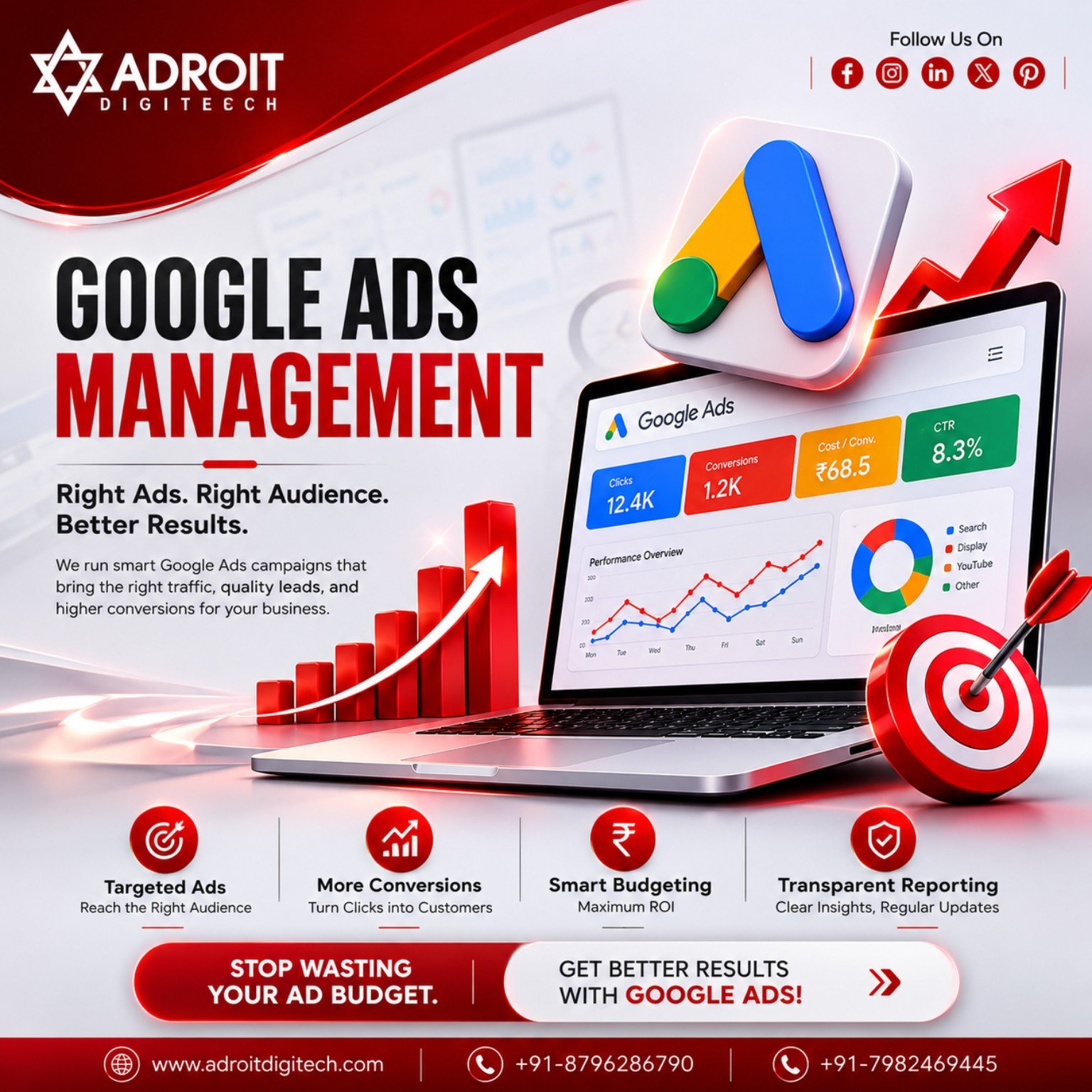
The image highlights this exact business problem with a clear message: “Stop Wasting Your Ad Budget. Get Better Results with Google Ads.” It presents Google Ads management not merely as advertising but as a performance-driven process built around targeted ads, more conversions, smart budgeting and transparent reporting.
For a local business competing in Delhi and Delhi NCR, this becomes even more important. Your competitors may already be appearing when potential customers search for the services you provide. If your campaigns are poorly targeted, your budget can disappear before the right customer ever reaches your business.
This is where professional Google Ads management becomes valuable.
Why Businesses Spend on Google Ads but Still Struggle to Get Customers
Imagine a Delhi-based business owner spending ₹30,000 every month on Google Ads. The campaign generates hundreds of clicks, but only a few enquiries become genuine customers.
At first, the business owner may think the solution is simple: increase the budget.
But more budget does not automatically mean better results.
If irrelevant searches are triggering advertisements, if keywords do not match customer intent, if the landing page is weak, if conversion tracking is inaccurate, or if the campaign is optimised for clicks rather than meaningful actions, increasing the budget can simply increase the amount of money being wasted.
This is the pain point behind the message shown in the image.
Google Ads should not be about getting the maximum number of clicks. It should be about getting the right clicks from people who have a genuine possibility of becoming customers.
What Is Google Ads Management?
Google Ads Management is the ongoing process of planning, launching, monitoring, analysing and improving paid advertising campaigns on Google.
It involves much more than creating an advertisement.
A properly managed campaign begins with understanding the business, its customers, services, competitors, geographical market and commercial objectives. From there, the campaign can be structured around relevant search terms, appropriate targeting, compelling ad messaging, suitable landing pages, conversion tracking and performance data.
Google’s current Smart Bidding system can use machine learning and auction-time signals to optimise bids toward conversions or conversion value. Google identifies strategies such as ‘maximise conversions’, ‘target CPA’, ‘maximise conversion value’ and ‘target ROAS’ according to different business goals.
That means modern Google Ads management is increasingly about feeding the system useful business data and making intelligent strategic decisions around it, rather than manually changing bids without understanding what the data is saying.
The Biggest Difference: Clicks vs. Conversions
One of the most common mistakes businesses make is judging campaign success only by clicks.
A campaign may generate 1,000 clicks, but if those visitors do not call, submit an enquiry, purchase a product or take another valuable action, the number of clicks alone means very little.
This is why the image focuses on “More Conversions – Turn Clicks into Customers”.
A conversion could be a phone call, contact-form submission, WhatsApp enquiry, appointment request, online purchase or another action that represents genuine business value.
For example, suppose a Delhi web development company receives 100 Google Ads clicks. Ten people submit enquiries, six are relevant prospects and two become paying clients.
Those two clients are ultimately more important to the business than the 100 clicks.
A good Google Ads strategy, therefore, asks the following:
How many qualified customers did the campaign help generate, and at what cost?
How Google Ads Can Reach Customers With Strong Purchase Intent
Google Search Ads have a major advantage for many businesses: they can appear when people are actively searching for a solution.
Someone searching for “Google Ads agency in Delhi” has a different level of intent from someone casually scrolling through social media.
Similarly, searches such as “website development company in Delhi NCR”, “SEO agency near me”, or “Google Ads management services Delhi” can indicate that the person is already researching a service provider.
This is why keyword selection matters.
A campaign should distinguish between broad informational searches and commercially valuable searches. Search intent helps determine whether someone is looking to learn, compare options, find a provider or take immediate action.
The goal is not to appear for every possible search.
The goal is to appear for the right searches.
Targeted Ads: Reaching the Right Audience
The first benefit highlighted in the image is Targeted Ads – Reach the Right Audience.
For a local business, targeting can be especially important.
A company serving Delhi NCR may not want to spend the same advertising budget reaching people thousands of kilometres away. Geographic targeting, campaign structure, keyword selection and location-specific messaging can help make advertising more relevant.
For example, a service business targeting Delhi, Noida, Gurugram, Ghaziabad and Faridabad may create campaigns and landing-page messaging that reflect its actual service areas.
But location targeting alone is not enough.
The audience also needs to be relevant in terms of search intent, device behaviour, time, service requirement and commercial interest.
Google’s automated bidding systems can evaluate contextual signals at auction time, including factors such as device, location and time of day, when determining bids.
This makes campaign strategy and data quality increasingly important.
Smart Budgeting: Why Every Rupee Should Have a Purpose
The image also communicates “Smart Budgeting – Maximum ROI”.
This is particularly important for small and medium-sized businesses.
Advertising budgets are not unlimited. A business may have ₹500 per day, ₹1,000 per day, ₹2,000 per day or a much larger monthly advertising budget. The right strategy depends on the business model, competition, customer value and conversion economics.
A professional campaign should, therefore, be built around questions such as the following:
How much can the business afford to pay for a qualified lead?
How much is an average customer worth?
Which services generate the highest profit?
Which keywords attract serious prospects?
Which campaigns generate enquiries but poor-quality leads?
Which campaigns actually generate customers?
These questions help move Google Ads management away from “spend money and hope” toward measurable decision-making.
Google states that ‘Maximise conversions’ is designed to use the budget to pursue as many conversions as possible, while target-based strategies can be used when a business has a specific cost or return objective.
Conversion Tracking Is the Foundation of Performance
One of the most overlooked parts of Google Ads is conversion tracking.
If the advertising platform cannot reliably understand which actions are valuable, optimisation becomes much harder.
Suppose someone clicks an advertisement and calls the business. If that meaningful action is not properly measured, the campaign data may not accurately reflect what is working.
Conversion tracking can help businesses understand which campaigns, keywords and advertisements are contributing to valuable customer actions.
Google specifically notes that conversion tracking is required for strategies such as Maximise conversions.
This is why professional campaign management should include measurement—not just advertisement creation.
What Happens When Google Ads Campaigns Are Poorly Managed?
Poorly managed campaigns often show a predictable pattern.
The business receives traffic but not enough qualified enquiries. Some searches may be irrelevant. Certain keywords consume budget without producing meaningful results. Advertisements may not communicate a strong value proposition. Landing pages may fail to persuade visitors. Tracking may be incomplete. Campaign settings may not match the actual business objective.
The result is frustrating:
The business is spending money, but the owner cannot clearly explain what that money is producing.
This uncertainty is often more damaging than the advertising cost itself because it prevents informed decisions.
Common Google Ads Mistakes Businesses Should Avoid
Choosing Keywords Without Understanding Search Intent
A keyword can have high search volume and still be commercially weak for a particular business.
Instead of chasing volume alone, businesses should understand why people are searching and whether that search can realistically lead to a customer.
Optimising Only for Clicks
Clicks are useful, but they are not the final business objective for most lead-generation campaigns.
If the goal is leads or sales, campaign optimisation should eventually reflect those outcomes.
Sending Every Advertisement to the Same Page
A customer searching for one specific service should ideally land on a page that clearly addresses that service.
If the advertisement says “Google Ads Management Services” but the landing page is a generic homepage containing dozens of unrelated services, the visitor may struggle to find what they expected.
Ignoring Negative or Irrelevant Searches
Search-term analysis is essential for identifying traffic that does not match the business.
Without ongoing optimisation, advertising spend can gradually move toward searches that generate activity without meaningful commercial value.
Changing Campaigns Without Enough Strategic Reason
Constantly changing targeting, bidding, keywords and campaign structures without understanding the learning process can make performance analysis more difficult.
Google’s Smart Bidding systems use machine learning and auction-time signals, so campaign changes should be made deliberately rather than randomly.
How to Choose the Right Google Ads Management Company
Choosing an agency should not be based only on the promise of “more leads”.
Ask how the agency approaches your business.
A professional Google Ads management company should be able to explain the campaign objective, audience, keyword strategy, conversion tracking, budget allocation, landing-page requirements, reporting process and optimisation approach in language you can understand.
Transparency matters.
You should know what your advertising budget is being used for and how performance is being measured.
The image reinforces this with “Transparent Reporting – Clear Insights, Regular Updates”.
That is an important distinction. A report filled with impressions and clicks may look impressive, but a business owner needs to understand what those numbers mean commercially.
Google Ads Management for Businesses in Delhi & Delhi NCR
Delhi NCR is a highly competitive market where customers have numerous options available to them.
A business in Delhi may be competing against established companies, local specialists, national brands and businesses aggressively investing in online advertising.
This makes local relevance important.
For example, a company offering legal marketing services may want visibility for searches connected to Delhi. A web development company may target Delhi NCR businesses. A local service provider in Noida may need campaigns focused specifically on customers within its service radius.
The strategy should reflect the actual market instead of applying one generic campaign structure to every business.
For businesses serving Delhi, Noida, Gurugram, Faridabad, Ghaziabad and other Delhi NCR locations, Google Ads can become a strong customer acquisition channel when campaigns are built around genuine search intent, appropriate geographical targeting and measurable conversion goals.
How Adroit Digitech Approaches Google Ads Management
Adroit Digitech approaches Google Ads management as a combination of advertising strategy, audience understanding, conversion optimisation and continuous performance analysis.
The objective is not simply to put an advertisement in front of as many people as possible.
The focus is on connecting the right search, right audience, right advertisement and right landing experience.
Campaigns can be planned around business objectives such as qualified leads, enquiries, sales or other measurable customer actions. Performance data can then be reviewed to identify opportunities for improvement.
For a Delhi NCR business, this can mean developing campaigns around relevant services and locations rather than treating the entire market as one audience.
The most important principle remains simple:
Right Ads. Right Audience. Better Results.
What Makes Google Ads Management Worth the Investment?
Google Ads can provide immediate visibility, but visibility alone is not the real value.
The real value comes when paid traffic becomes measurable business activity.
A well-managed campaign can help a business understand which services customers are actively searching for, which messages attract attention, which keywords produce qualified prospects and where advertising money is producing the strongest commercial return.
It also provides data that can influence other marketing decisions.
For example, if a particular service consistently generates profitable enquiries through Google Search, the business may decide to create stronger organic SEO content around that service as well.
Paid advertising and SEO can therefore complement each other rather than operating as completely separate strategies.
Frequently Asked Questions About Google Ads Management
What is Google Ads Management?
Google Ads Management is the process of planning, creating, monitoring, analysing and continuously optimising Google advertising campaigns to achieve specific business objectives such as leads, sales, calls or conversions.
How much does Google Ads management cost in Delhi?
The cost depends on campaign complexity, number of services, target locations, competition, advertising budget and management requirements. The advertising budget paid to Google and the professional management fee are generally separate considerations.
Is Google Ads better than SEO?
Neither is automatically better for every business. Google Ads can provide paid visibility and capture existing search demand, while SEO focuses on improving organic visibility. Many businesses benefit from using both strategically.
Can Google Ads generate leads for local businesses?
Yes. Local businesses can use Google Ads to reach people searching for relevant products or services in their target market. Results depend on factors such as search demand, competition, campaign quality, offer, landing page and conversion process.
Why are my Google Ads getting clicks but no customers?
Possible reasons include poor keyword targeting, irrelevant traffic, weak advertisements, an ineffective landing page, inaccurate conversion tracking, poor lead handling or an offer that does not match customer expectations.
Should a small business use Google Ads?
A small business can benefit from Google Ads when the campaign economics make sense. Before launching, it is important to understand the potential customer value, acceptable acquisition cost, available budget and realistic conversion expectations.
Does Google Ads guarantee leads or sales?
No. Google Ads cannot guarantee a particular number of leads or sales. Campaign performance depends on competition, demand, targeting, advertising quality, website experience, offer and many other factors.
How can I reduce wasted Google Ads spending?
Start by defining valuable conversions, improving keyword and search-intent targeting, reviewing search terms, refining geographical targeting, improving advertisements and landing pages, and analysing performance against actual business outcomes rather than clicks alone.
Final Thoughts: Stop Wasting Your Ad Budget
The strongest message in the image is not simply “Google Ads Management”.
It is the message behind it:
Your advertising budget should work toward business results.
If your campaigns are generating clicks but not qualified customers, increasing the budget may not solve the underlying problem. The smarter approach is to understand where the money is going, who is responding, which searches have commercial intent and which actions actually contribute to business growth.
Google’s current automated bidding systems are increasingly designed to optimise toward conversions and conversion value using real-time auction signals, making accurate conversion measurement and a clear business objective more important than ever.
For businesses in Delhi and Delhi NCR, the opportunity is significant—but competition is equally strong.
The goal should never be to advertise everywhere.
Advertise where the right customers are searching.
Reach the right audience.
Control your budget intelligently.
Measure meaningful conversions.
Keep improving.
And most importantly, turn advertising spend into a measurable growth opportunity.

Dead composed subject matter, Really enjoyed studying.