

Mobile App Development Company in Delhi NCR: Build Scalable Apps That Turn Business Ideas Into Growth
Imagine a customer searching for your service, finding your business, opening your app—and completing a booking, purchase, payment, or enquiry in a few taps.
Now imagine the opposite.
Your customer has to call, wait for a response, visit a website that is difficult to use on mobile, or message your team repeatedly just to get a simple service. In a market where customers expect convenience, that friction can quietly push them toward a competitor.
This is the real reason businesses invest in mobile applications. A mobile app is not simply another digital presence. When planned properly, it can become a direct customer channel, sales platform, booking system, communication tool, loyalty engine, and operational dashboard.
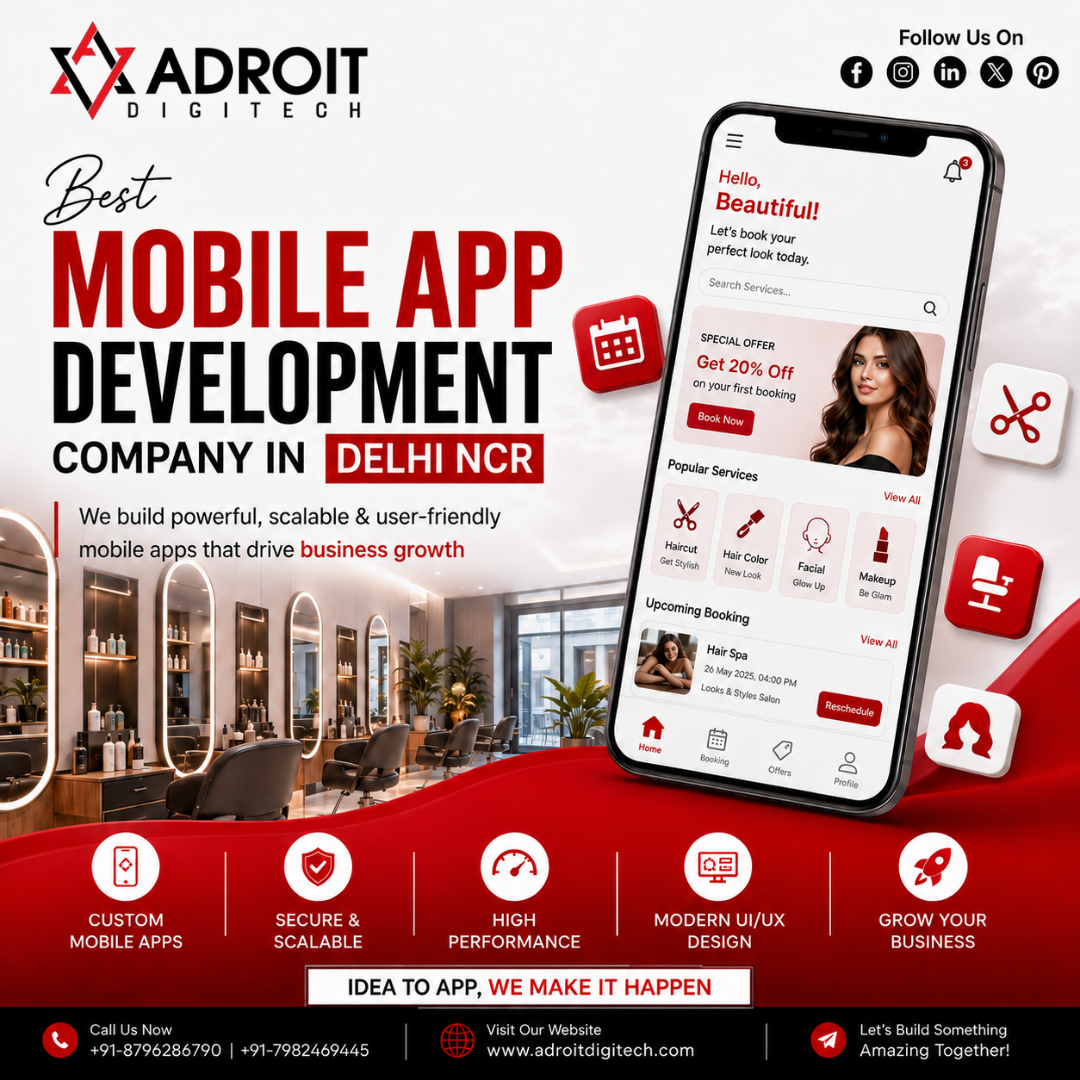
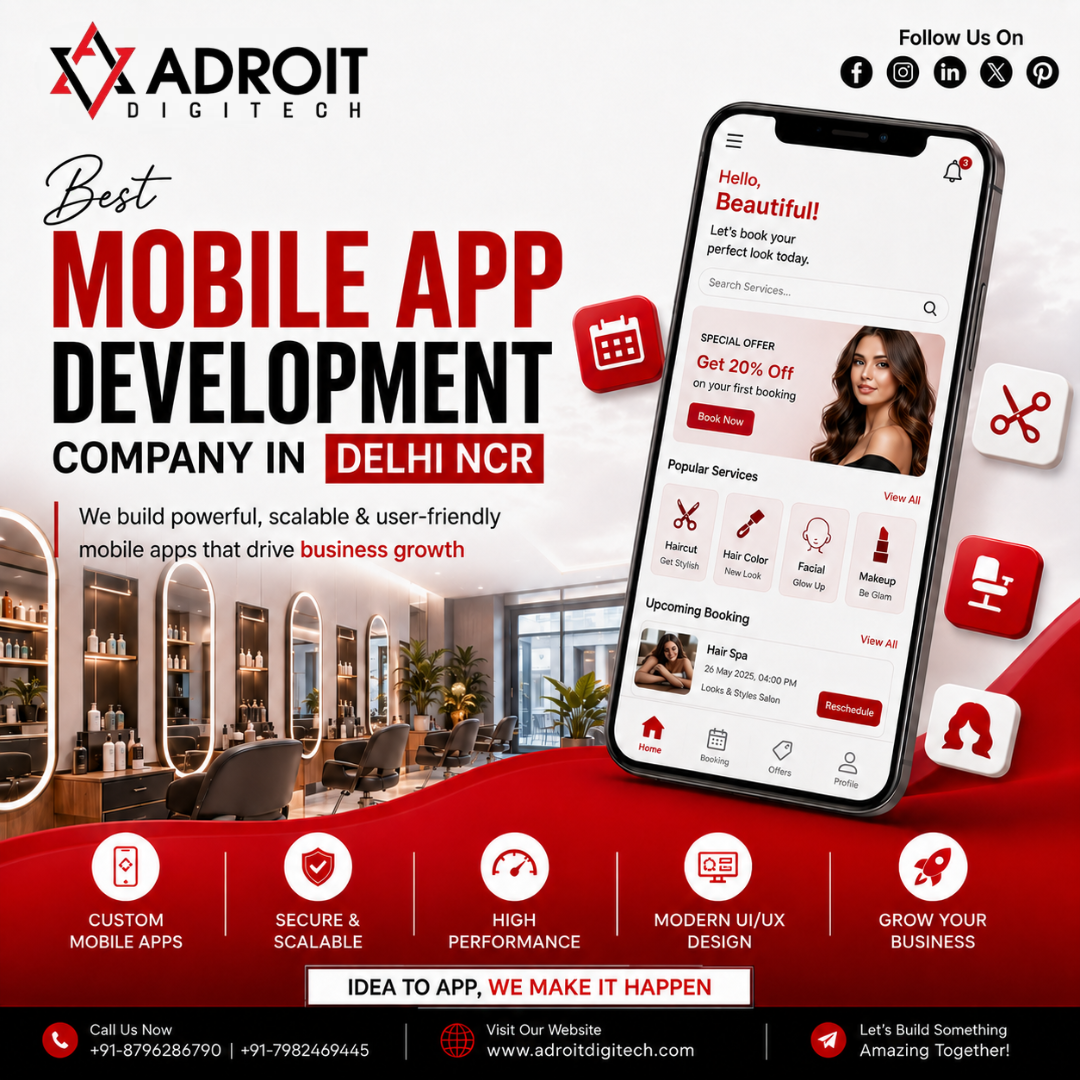
The visual message in the featured Adroit Digitech creative captures this idea clearly: “Best Mobile App Development Company in Delhi NCR”, with the promise of building powerful, scalable and user-friendly mobile apps that drive business growth. The salon-booking interface shown in the image is one practical example, but the underlying solution is much broader: businesses across industries can use custom mobile applications to simplify customer journeys and improve operations.
For companies looking for a mobile app development company in Delhi NCR, the important question is therefore not simply, “Can someone build an app?” The better question is: Can the app solve a genuine business problem, deliver a smooth user experience and remain useful as the business grows?
Why Businesses Need More Than Just a Mobile-Friendly Website
A responsive website is important, but it does not always replace the convenience of a dedicated mobile application.
Consider a salon customer. They may want to browse services, see an offer, choose a stylist, book an appointment, receive a reminder and reschedule without calling the reception desk. The app shown in the image demonstrates exactly this type of experience through service discovery, special offers, booking information and profile functionality.
The same principle applies to other businesses.
An eCommerce company may need product discovery, a shopping cart, payment integration and order tracking. A healthcare provider may need appointment booking, patient communication and reminders. A logistics company may require GPS tracking and delivery updates. An educational platform may need courses, notifications, assessments and student dashboards.
The application should therefore be designed around the customer journey and business workflow, rather than around a collection of fashionable features.
The Customer Pain Point: Too Much Friction Means Lost Business
Customers rarely complain about “poor software architecture”. They complain because something takes too long.
They cannot find the right service. The checkout fails. A booking is difficult to change. Notifications arrive late. The interface is confusing. The app takes too long to load. They have to enter the same information repeatedly.
These small problems accumulate.
For a service business, one abandoned booking can mean lost revenue. For an eCommerce brand, a complicated checkout can mean an abandoned cart. For an enterprise, an inefficient internal app can waste employee time every day.
That is why custom mobile app development should begin with a problem statement.
Instead of asking, “What features should our app have?”, a business should ask:
What is currently frustrating our customers or employees, and how can mobile technology remove that friction?
That change in thinking often produces a much better product.
What Makes a Business Mobile App Successful?
A successful mobile application balances four things: usability, performance, security and scalability.
The image highlights several of these principles directly—custom mobile apps, secure and scalable architecture, high performance, modern UI/UX and business growth.
Modern UI/UX Is a Business Function, Not Decoration
A beautiful interface is useful only when customers can understand it quickly.
Good mobile app UX/ UI design makes important actions obvious. Navigation should feel natural. Forms should not be unnecessarily long. Buttons should be easy to tap. Information should appear where users expect it.
For example, in a booking application, “Book Now” should not be hidden behind several screens. Service categories should be easy to scan. Upcoming bookings should be accessible without making the customer search through their account.
Adroit Digitech’s UX/UI service covers mobile app interfaces, wireframing, prototypes, user flows and interactive UI components, with the goal of making digital products easier and more engaging to use.
Performance Directly Affects User Experience
A customer may forgive a business for not having a particular feature. They are much less likely to tolerate an app that repeatedly freezes or takes too long to respond.
Performance planning should therefore happen during development, not after launch.
Developers need to consider API response times, image optimisation, database queries, caching, device compatibility, network conditions and application architecture.
The goal is simple: the app should feel fast during the actions customers perform most often.
Security Cannot Be an Afterthought
Mobile applications may process names, phone numbers, addresses, payment information, business records and other sensitive data.
A professional development approach should therefore consider authentication, authorisation, secure API communication, data protection, session management and appropriate third-party integrations.
Security is especially important for applications involving payments, healthcare information, employee systems or customer accounts.
Scalability Determines Whether the App Can Grow With You
An application that works for 500 users may behave very differently when 50,000 people start using it.
Scalable architecture allows businesses to introduce new features, support increasing traffic and connect additional systems without rebuilding the entire application.
This is particularly important for startups. A minimum viable product may begin with a limited feature set, but the underlying technology should not make future growth unnecessarily difficult.
Mobile App Development Services for Different Business Needs
There is no single type of mobile application. The right development approach depends on the business model, users, budget and technical requirements.
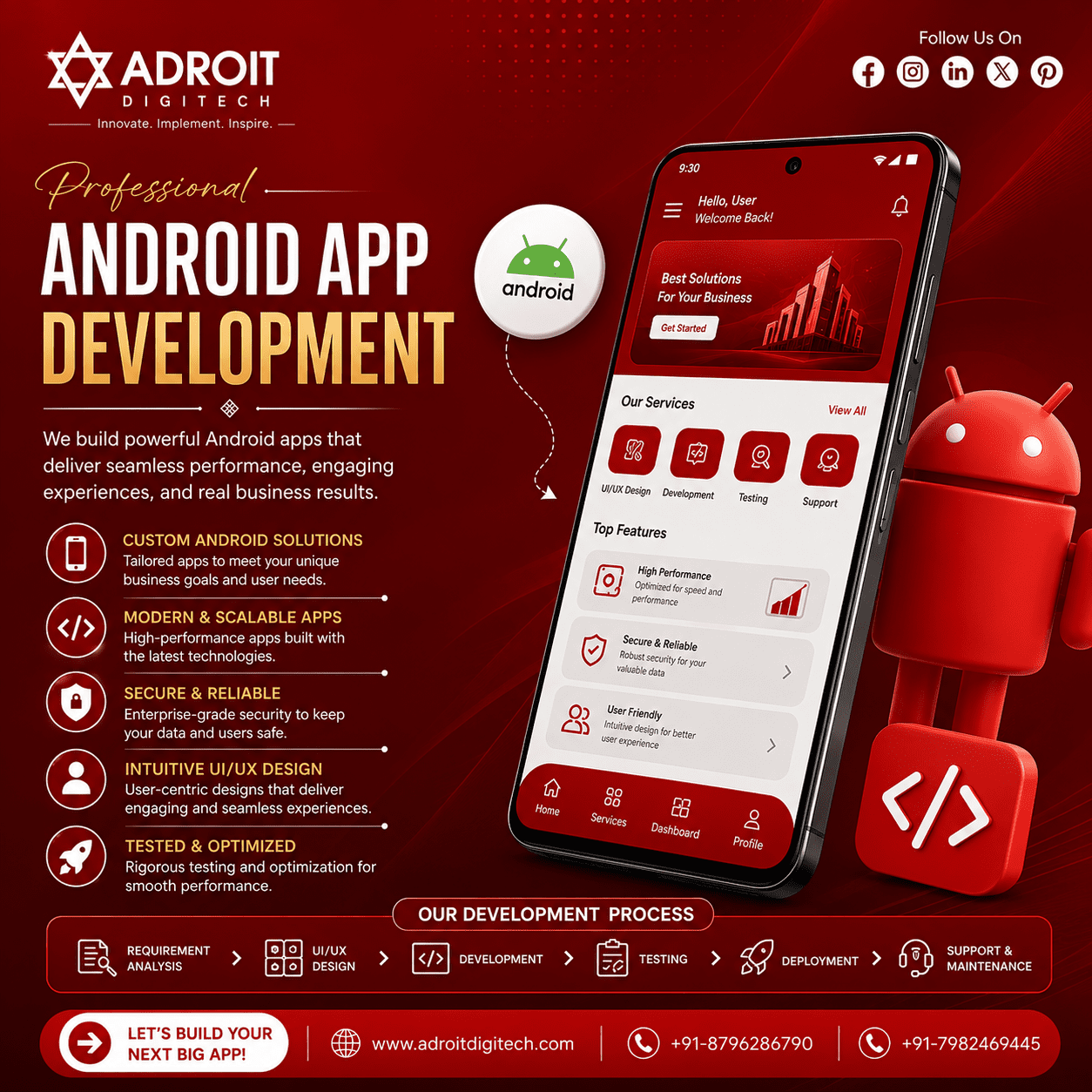
Android App Development
Android remains essential for businesses that want broad smartphone reach. A custom Android application can be designed around the specific needs of customers, employees or business operations.
Typical Android solutions include customer apps, eCommerce applications, booking platforms, delivery apps, enterprise applications and service marketplaces.
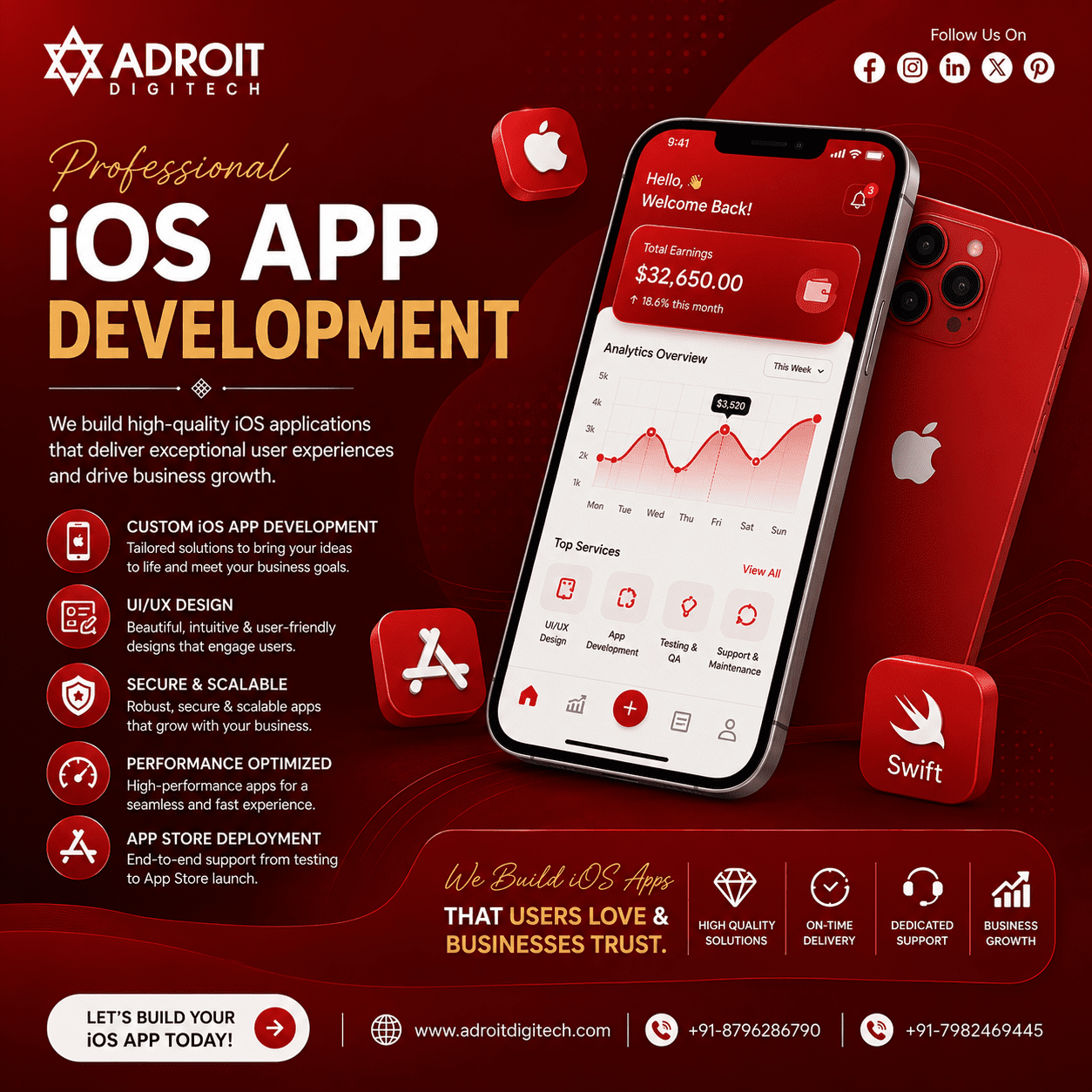
iOS App Development
Businesses targeting Apple users may require a dedicated iOS experience with platform-specific design and functionality.
For premium consumer brands, professional services, startups and businesses with a significant iPhone customer base, iOS development can be an important part of the mobile strategy.
Cross-Platform and Hybrid App Development
When a company needs Android and iOS applications while keeping development efficient, cross-platform development can be an attractive option.
Adroit Digitech’s published mobile app content highlights technologies such as Flutter, React Native, Ionic and HTML5 for cross-platform solutions. A shared codebase can help reduce duplication and simplify maintenance when the project is well suited to that approach.
However, cross-platform development should not be selected merely because it sounds cheaper. The technology should match the app’s performance requirements, device integrations and long-term roadmap.
eCommerce Mobile App Development
An eCommerce app can bring the complete shopping journey into one environment.
Depending on the business, this may include product catalogues, search and filters, customer accounts, wish lists, cart management, payment gateways, order tracking, offers, notifications and customer support.
The important point is that the app should make buying easier—not simply reproduce every page of an existing website.
On-Demand Service Apps
The salon interface in the image is a strong example of an on-demand/service-booking model.
A similar application could be created for home cleaning, repair services, fitness trainers, beauty professionals, consultants, car services, tutors or other appointment-based businesses.
Features may include service selection, availability, booking, cancellation, rescheduling, payments, offers, reviews, notifications and customer profiles.
Healthcare Mobile Apps
Healthcare applications may support appointment scheduling, doctor discovery, reminders, patient communication, reports or teleconsultation workflows.
Because healthcare involves sensitive information, product planning should place security, privacy and appropriate access controls at the centre of development.
Education and eLearning Apps
Schools, institutes, coaching businesses and online educators can use mobile applications for lessons, assessments, notifications, attendance, student communication and course management.
A good education app should make learning easier to access while giving administrators useful tools for managing content and users.
Real Estate Apps
A real estate mobile app can help users discover properties, filter listings, save favourites, request information and schedule visits.
For real estate companies, the application can also become a lead-generation and customer-management channel.
Logistics and Delivery Apps
Delivery businesses often need more complex functionality, including live location, delivery status, driver workflows, customer notifications and administrative dashboards.
In such cases, mobile development may involve several connected applications or user roles rather than one simple customer app.
Enterprise and Custom Business Apps
Not every mobile app needs to be public.
A company may need an internal application for field employees, sales teams, inventory management, attendance, approvals, reporting or customer relationship workflows.
These custom enterprise applications can reduce manual processes and make business information accessible to employees while they are away from their desks.
What Should the Mobile App Development Process Look Like?
A reliable app is rarely created by jumping directly into coding.
The process should begin with discovery and requirements analysis. The development team needs to understand the target audience, business objectives, competitors, user journeys, required integrations and expected outcomes.
Next comes UX planning and UI design. Wireframes help establish the structure, while prototypes allow stakeholders to experience important journeys before full development begins.
Development then converts those approved designs into a working application, connecting the mobile interface with APIs, databases, payment systems, maps, notifications or other required services.
Testing should cover functionality, usability, performance, security and device compatibility.
Finally, the application is prepared for deployment and ongoing maintenance. Launch should not be considered the end of the project. Updates, bug fixes, performance monitoring and feature improvements are part of maintaining a useful business application.
Common Mobile App Development Mistakes Businesses Should Avoid
One common mistake is trying to include every possible feature in version one.
A better approach is to identify the core problem and build the smallest useful version that can solve it. Customer feedback can then guide future improvements.
Another mistake is focusing heavily on appearance while ignoring UX. A visually impressive app can still fail if customers cannot complete important tasks easily.
Businesses also sometimes underestimate backend requirements. A mobile interface is only one part of the product. APIs, databases, authentication, integrations and administrative systems often determine whether the application works reliably.
Poor testing is another risk. Testing only on one modern smartphone does not represent the real-world environment. Customers may use different screen sizes, operating-system versions, network conditions and devices.
Finally, businesses sometimes treat maintenance as optional. Mobile operating systems, security requirements, APIs and customer expectations change. An app needs ongoing technical attention to remain reliable.
How to Choose the Right Mobile App Development Company in Delhi NCR
Choosing a development partner should involve more than comparing quotations.
Start by examining whether the company understands your business model. A developer who understands bookings, payments, subscriptions, marketplaces or enterprise workflows can contribute more effectively than someone simply taking a feature list and writing code.
Ask about the technology approach. If you need Android and iOS, discuss whether native or cross-platform development is more appropriate.
Review the proposed UX process. Does the company create wireframes and prototypes? How will user journeys be validated?
Discuss testing, security, deployment and post-launch maintenance before signing the project.
Most importantly, ask how the development team measures success. “The app is live” is not the same as “the app is helping the business.”
A good partner should be interested in outcomes such as completed bookings, repeat purchases, customer engagement, operational efficiency or lead generation.
Why Delhi NCR Businesses Need a Locally Relevant Development Partner
Delhi NCR is a highly competitive business environment covering diverse markets in Delhi, Noida, Gurugram, Faridabad, Ghaziabad and Greater Noida.
A local business may be competing not only with established companies but also with digitally native startups that offer customers faster online experiences.
That makes mobile technology particularly valuable for businesses that depend on repeat customers, local bookings, online enquiries or digital transactions.
Adroit Digitech positions itself as a Delhi-based digital solutions company serving businesses across Delhi NCR. Its current website lists mobile app solutions alongside UX/UI design, website development, SEO, PPC, social media marketing and other digital services.
This broader capability can be useful when an app is part of a larger digital growth strategy. A mobile application may need a website, landing pages, SEO, paid campaigns, social media promotion or analytics to attract users after launch.
Why Adroit Digitech Fits the Message of the Featured Creative
The featured creative is built around a straightforward business promise: “Idea to App, We Make It Happen.”
That message matters because many business owners have an app idea but do not know how to turn it into a technically viable product.
Adroit Digitech presents its mobile app offering around the same principles shown in the image: custom development, security, scalability, performance, modern UI/UX and business growth. Its current digital presence also confirms a wider focus on UX/UI, website development, SEO and digital marketing.
For businesses considering Android, iOS or cross-platform development, the practical advantage is being able to discuss the application as part of the overall customer journey rather than as an isolated piece of software.
The company also publishes information about hybrid development using Flutter, React Native, Ionic and HTML5, with use cases spanning eCommerce, healthcare, education, real estate and on-demand services.
That makes the salon-style application shown in the image a useful example—not a limitation. The same development thinking can be adapted to many different business models.
A Mobile App Should Solve a Business Problem First
The strongest mobile applications do not begin with technology.
They begin with a customer who needs something.
A person wants to book an appointment without calling. A shopper wants to reorder quickly. A patient wants to schedule a consultation. A field employee needs information while travelling. A customer wants to track a delivery.
Technology becomes valuable when it removes the friction between that need and the desired outcome.
That is why choosing a mobile app development company in Delhi NCR should be about more than coding capability. Businesses need a partner that can understand users, design intuitive experiences, build secure and scalable technology, test thoroughly and continue improving the product after launch.
Whether the requirement is an Android app, iOS application, Flutter app, React Native app, hybrid solution, eCommerce app, booking platform, on-demand service app, healthcare app, education app, real estate app, logistics application or custom enterprise mobile solution, the development strategy should ultimately serve one purpose: making the business easier to use, easier to manage and easier to grow.
Frequently Asked Questions
How much does mobile app development cost in Delhi NCR?
There is no single price because cost depends on the number of platforms, features, UI/UX complexity, backend requirements, third-party integrations, security needs and maintenance scope. A simple business app and a multi-vendor marketplace can have completely different development requirements.
How long does it take to develop a mobile app?
A basic application may take considerably less time than a complex platform involving payments, real-time tracking, multiple user roles or extensive integrations. A realistic timeline should be estimated after requirements, user flows and technical architecture are defined.
Should I build an Android app, an iOS app or both?
The answer depends on your target customers and business goals. If your audience is concentrated on one platform, starting there may make sense. If you need broad market coverage, native or cross-platform development can be evaluated.
Is Flutter suitable for business mobile apps?
Flutter can be a strong option for many applications that need Android and iOS support from a shared development approach. However, the right framework should be selected after considering performance, integrations, device features and long-term maintenance requirements.
Can a mobile app integrate with my existing website or software?
Yes. Mobile applications can communicate with existing systems through APIs and other integrations. This can allow the app to use customer accounts, inventory, orders, bookings, payments or other business data already managed by the company.
Can Adroit Digitech build an app for industries other than salons?
Yes. The service approach shown in the image can be adapted beyond beauty and salon businesses. Mobile applications can be developed for eCommerce, healthcare, education, real estate, logistics, on-demand services, startups, enterprises and other business models.
Why is UI/UX important in mobile app development?
UI/UX determines how easily users understand and navigate the application. Good UX reduces friction, while effective UI makes important actions clear and consistent. Together they can improve engagement, satisfaction and conversions.
Can a mobile application scale as the business grows?
Yes, provided scalability is considered during architecture and backend planning. A well-designed application can support additional users, features and integrations without requiring a complete rebuild.
Ready to Turn Your App Idea Into a Working Business Solution?
Your app idea does not have to remain a concept on paper.
If you are planning an Android, iOS, Flutter, React Native, hybrid, eCommerce, booking, on-demand, healthcare, education, real estate, logistics or custom enterprise mobile application, start by defining the customer problem you want to solve.
Then choose a development partner that can translate that problem into a secure, scalable, high-performance and genuinely usable product.
Adroit Digitech helps businesses across Delhi NCR move from idea to mobile application with custom development, modern UI/UX and a broader digital-growth perspective.
Short CTA: Have a mobile app idea? Let Adroit Digitech turn it into a scalable digital product.